Is Mathnasium Worth It for Middle Schoolers? A 2026 Parent Review
May 29, 2026
Mathnasium has been around since 2002, and depending on who you ask, it's either a solid math foundation or an expensive worksheet routine. For middle schoolers especially — where the math actually starts to matter — the stakes of picking the wrong support are higher.
This review breaks down what Mathnasium actually offers, what parents tend to find once they're enrolled, and whether the cost is actually worth it. If you're comparing options, there's also a note at the end on what to consider instead.
This review breaks down what Mathnasium actually offers, what parents tend to find once they're enrolled, and whether the cost is actually worth it. If you're comparing options, there's also a note at the end on what to consider instead.
What Mathnasium Actually Is (and How It Works)
Mathnasium is a franchise tutoring center network with more than 1,000 locations in the US. Students come in for sessions a few times a week and work through what the company calls the Mathnasium Method — a structured, largely worksheet-based approach that starts with an assessment to identify gaps, then fills them in order.
The model is not one-on-one tutoring. Centers typically run sessions with a group of students at once, each working through their individual plan while an instructor circulates to answer questions. Think of it less like a private lesson and more like a supervised math study hall with a curriculum built around your child's specific gaps.
For middle schoolers, the curriculum covers everything from fractions and ratios to pre-algebra, algebra concepts, and early geometry. All of these are genuinely high-leverage skills that affect how students perform from 8th grade onward.
The model is not one-on-one tutoring. Centers typically run sessions with a group of students at once, each working through their individual plan while an instructor circulates to answer questions. Think of it less like a private lesson and more like a supervised math study hall with a curriculum built around your child's specific gaps.
For middle schoolers, the curriculum covers everything from fractions and ratios to pre-algebra, algebra concepts, and early geometry. All of these are genuinely high-leverage skills that affect how students perform from 8th grade onward.
Where Mathnasium Tends to Work Well for Middle Schoolers
While Mathnasium has helped a lot of kids, it does tend to work best in specific situations.
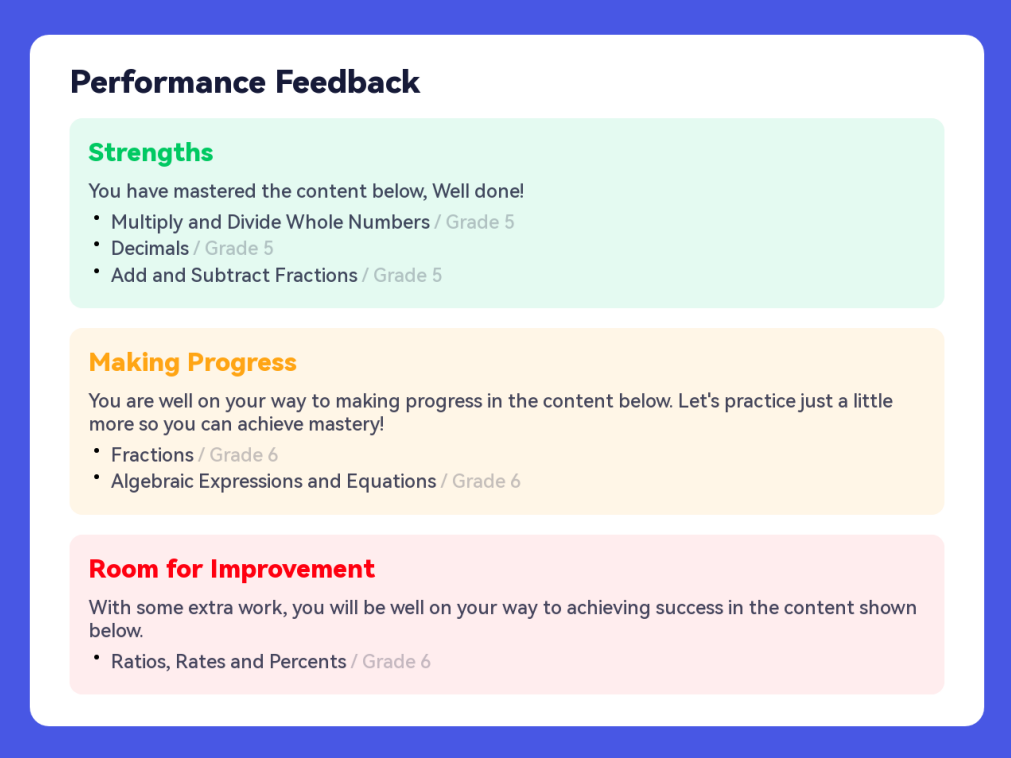
Gap-filling for procedural skills. If your child has a specific, identifiable hole — perhaps they never really locked down fraction operations and it's now causing problems in every new unit — Mathnasium's diagnostic approach is well-designed for that. The assessment is thorough, and the curriculum's scaffolding is logically sequenced.
Consistency and accountability. Some kids do better with a physical space, a set schedule, and the low-key social pressure of sitting next to other kids who are working. If your child needs structure outside of school, the in-center routine can help.
Elementary gaps surfacing in middle school. A lot of 6th and 7th graders hit a wall because foundational skills from 3rd–5th grade were never fully solidified. Mathnasium is built to work back through those foundations, which can be genuinely useful at this stage.
Gap-filling for procedural skills. If your child has a specific, identifiable hole — perhaps they never really locked down fraction operations and it's now causing problems in every new unit — Mathnasium's diagnostic approach is well-designed for that. The assessment is thorough, and the curriculum's scaffolding is logically sequenced.
Consistency and accountability. Some kids do better with a physical space, a set schedule, and the low-key social pressure of sitting next to other kids who are working. If your child needs structure outside of school, the in-center routine can help.
Elementary gaps surfacing in middle school. A lot of 6th and 7th graders hit a wall because foundational skills from 3rd–5th grade were never fully solidified. Mathnasium is built to work back through those foundations, which can be genuinely useful at this stage.
Where Parents Run Into Problems
The complaints parents report most often fall into a few consistent categories — and they're worth understanding before you commit.
It's not truly personalized instruction. A few parents expressed that Mathnasium could offer good help at foundational level, but is not as effective as private tutoring. The learning plan is personalized, but the instruction isn't. In a session with three to six students, a tutor can't sit with your child for more than a few minutes at a time. If your seventh grader is stuck on a concept and needs someone to explain it three different ways until it clicks, that's difficult to deliver in a shared environment. Most middle school math struggles at this stage aren't about missing worksheets — they're about understanding why a concept works, not just how to execute the procedure.
The model depends heavily on the franchise location. Mathnasium is a franchise — and Mathnasium itself markets it as a low-barrier business to own and manage. That's worth knowing as a parent, because it explains why quality varies so much by location. The curriculum is standardized, but the instructors — often high school or college students — are not. Two centers in the same city can have dramatically different outcomes depending on who's running the session on a given Tuesday.
Conceptual depth can be limited. Middle school is where math stops being about computation and starts being about reasoning. Proportional thinking, algebraic reasoning, and geometric proof require a student to build mental models — not just practice steps. Mathnasium's method is strong at procedural fluency, but parents of 7th and 8th graders frequently report that their child can pass the worksheet exercises without understanding the underlying concept. NWEA research on math achievement trends supports the distinction between procedural fluency and conceptual understanding at this level. That gap tends to catch up with students in algebra and beyond.
Middle school is harder to serve than elementary. Mathnasium was originally designed with younger learners in mind. The elementary program is focused on numeracy and basic operations and fits the model cleanly. Middle school math is more varied, moves faster, and demands more sophisticated problem-solving. Some centers handle it well; others effectively put middle schoolers on what feels like an extended 5th-grade remediation loop.
It's a significant monthly commitment. Pricing varies by location, but most families report paying between $300 and $500 per month for two to three sessions a week — not cheap, especially compared to one-on-one tutoring options that give your child a dedicated teacher for the full session. And the most common frustration among parents who stop is that after three or four months, they couldn't point to a concrete change in how their child understood math, even if worksheet scores had improved.
It's not truly personalized instruction. A few parents expressed that Mathnasium could offer good help at foundational level, but is not as effective as private tutoring. The learning plan is personalized, but the instruction isn't. In a session with three to six students, a tutor can't sit with your child for more than a few minutes at a time. If your seventh grader is stuck on a concept and needs someone to explain it three different ways until it clicks, that's difficult to deliver in a shared environment. Most middle school math struggles at this stage aren't about missing worksheets — they're about understanding why a concept works, not just how to execute the procedure.
The model depends heavily on the franchise location. Mathnasium is a franchise — and Mathnasium itself markets it as a low-barrier business to own and manage. That's worth knowing as a parent, because it explains why quality varies so much by location. The curriculum is standardized, but the instructors — often high school or college students — are not. Two centers in the same city can have dramatically different outcomes depending on who's running the session on a given Tuesday.
Conceptual depth can be limited. Middle school is where math stops being about computation and starts being about reasoning. Proportional thinking, algebraic reasoning, and geometric proof require a student to build mental models — not just practice steps. Mathnasium's method is strong at procedural fluency, but parents of 7th and 8th graders frequently report that their child can pass the worksheet exercises without understanding the underlying concept. NWEA research on math achievement trends supports the distinction between procedural fluency and conceptual understanding at this level. That gap tends to catch up with students in algebra and beyond.
Middle school is harder to serve than elementary. Mathnasium was originally designed with younger learners in mind. The elementary program is focused on numeracy and basic operations and fits the model cleanly. Middle school math is more varied, moves faster, and demands more sophisticated problem-solving. Some centers handle it well; others effectively put middle schoolers on what feels like an extended 5th-grade remediation loop.
It's a significant monthly commitment. Pricing varies by location, but most families report paying between $300 and $500 per month for two to three sessions a week — not cheap, especially compared to one-on-one tutoring options that give your child a dedicated teacher for the full session. And the most common frustration among parents who stop is that after three or four months, they couldn't point to a concrete change in how their child understood math, even if worksheet scores had improved.
What to Ask Before You Sign Up
If you're leaning toward trying Mathnasium, these questions are worth raising at your consultation:
1. What's the typical instructor-to-student ratio during a session at your location? 2. What percentage of your current middle school students come in for algebra or pre-algebra work, and how does your program address the conceptual side of those topics? 3. How will I know if my child is progressing? What does a progress report actually look like? And how often do I receive that? 4. What's the average tenure of your instructors? Are they college students, certified teachers, or something else? Mathnasium is worth considering if your middle schooler has well-defined foundational gaps (multiplication, fractions, basic ratios), learns well in structured environments with consistent routines, and doesn't need deep conceptual explanation — just guided practice to catch up to grade level.
It's likely not the right fit if your child is working at the algebra or pre-algebra level and struggling to understand why concepts work, not just how to apply them. Or if your schedule doesn't allow for regular in-center visits. Or if you've noticed that your child shuts down in group settings when they feel confused and don't want peers to see them struggling.
1. What's the typical instructor-to-student ratio during a session at your location? 2. What percentage of your current middle school students come in for algebra or pre-algebra work, and how does your program address the conceptual side of those topics? 3. How will I know if my child is progressing? What does a progress report actually look like? And how often do I receive that? 4. What's the average tenure of your instructors? Are they college students, certified teachers, or something else? Mathnasium is worth considering if your middle schooler has well-defined foundational gaps (multiplication, fractions, basic ratios), learns well in structured environments with consistent routines, and doesn't need deep conceptual explanation — just guided practice to catch up to grade level.
It's likely not the right fit if your child is working at the algebra or pre-algebra level and struggling to understand why concepts work, not just how to apply them. Or if your schedule doesn't allow for regular in-center visits. Or if you've noticed that your child shuts down in group settings when they feel confused and don't want peers to see them struggling.
How Cosmo Fills the Gaps
The limitations parents describe with Mathnasium — limited one-on-one time, variable instructor quality, and a curriculum that prioritizes procedure over conceptual understanding — are exactly what Cosmo is built around solving.
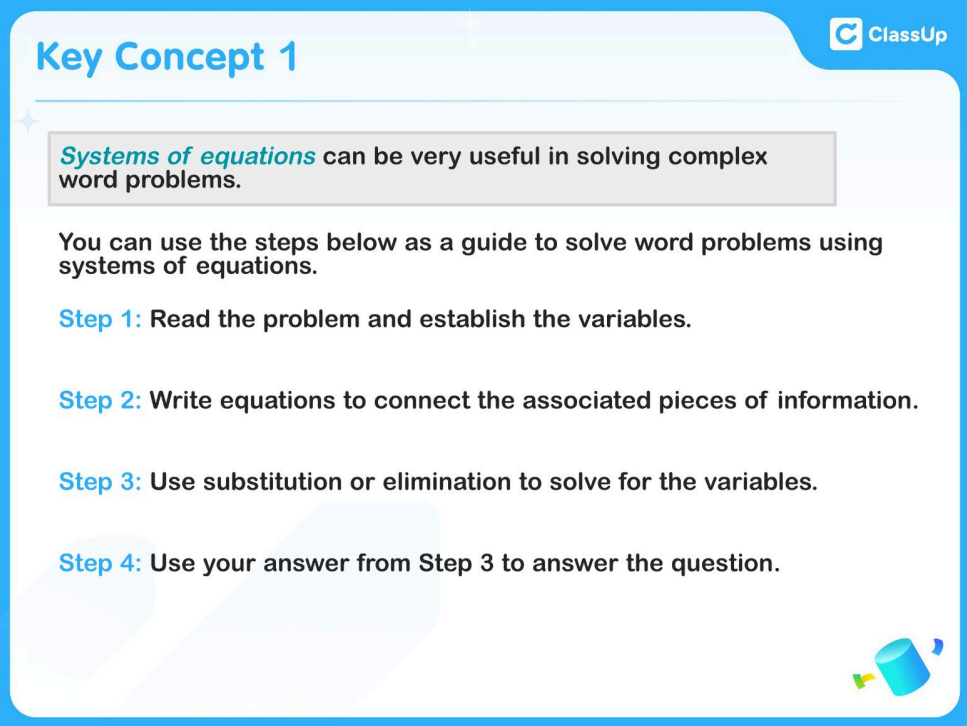
Every Cosmo session is live and one-on-one. There's no shared session, no waiting for your turn, and no instructor circulating between four other kids. Your child gets a single teacher whose entire job for that 50 minutes is to figure out exactly where their thinking is breaking down and address it directly. For a 7th grader who understands 80% of a pre-algebra unit but freezes on one specific type of problem, that matters enormously.
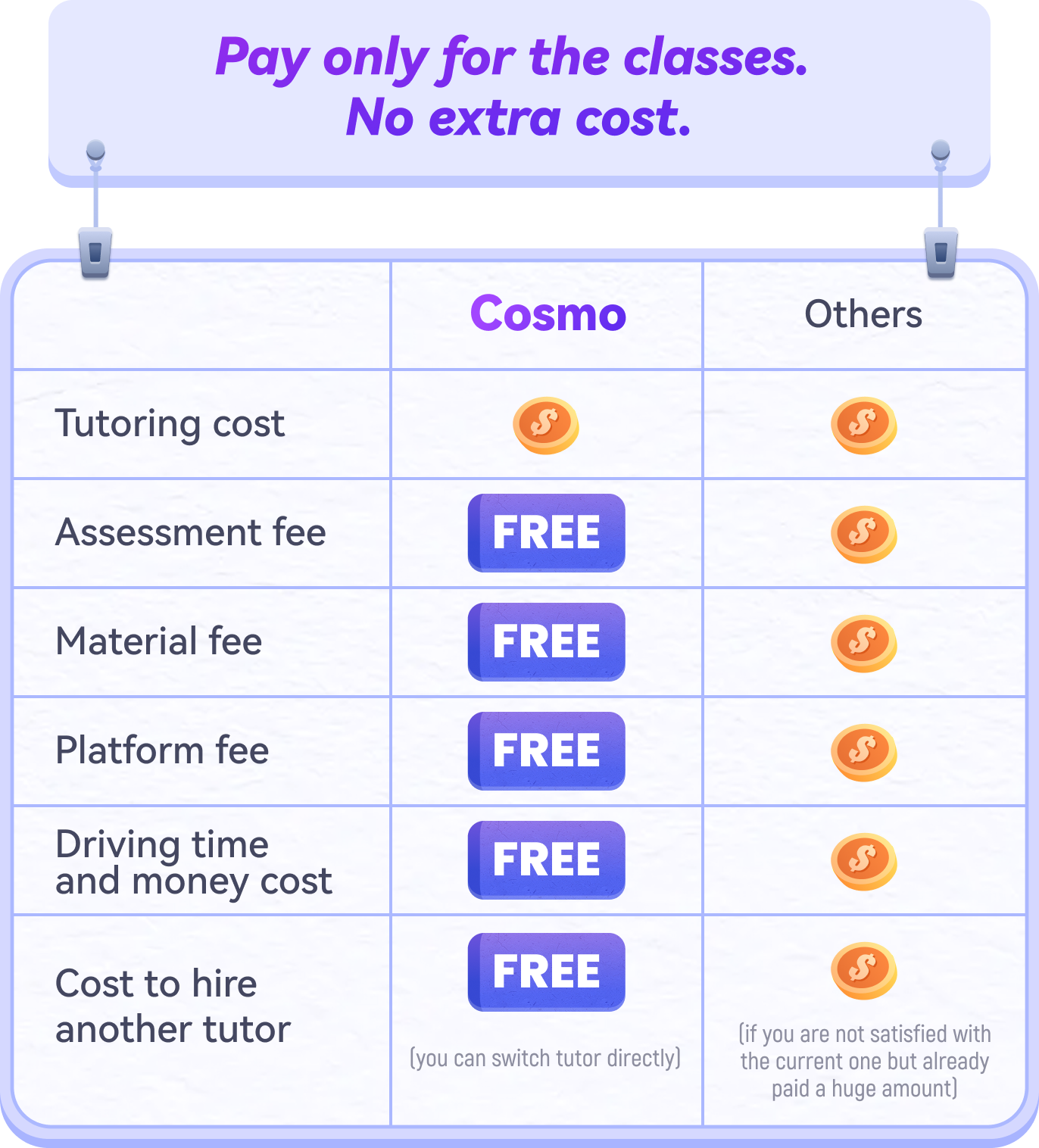
Beyond the teaching model, the cost structure is also different. Unlike Mathnasium — which often layers on assessment fees, material fees, and platform fees on top of tuition — Cosmo charges only for the classes themselves. No registration fees, no materials, no hidden costs.
Beyond the teaching model, the cost structure is also different. Unlike Mathnasium — which often layers on assessment fees, material fees, and platform fees on top of tuition — Cosmo charges only for the classes themselves. No registration fees, no materials, no hidden costs.
Cosmo also recruits and retains experienced educators, not college students working part-time. That difference shows up most clearly in middle school math, where the ability to explain proportional reasoning or algebraic thinking in multiple ways isn't a nice-to-have. It's what makes the session actually move the needle.
If your child has been at Mathnasium and is seeing incremental gains on worksheets but still can't explain their reasoning out loud — or if they're entering algebra and need someone to build genuine conceptual understanding from the ground up — a live, one-on-one session with the right teacher is a different experience entirely.
Cosmo's live math classes are designed around exactly this kind of conceptual gap — not just drilling procedures, but building the reasoning your child will need in every math class going forward. If you're not sure where your child stands, a single diagnostic trial session can tell you more than a semester of report cards. Book a free trial class today →
If your child has been at Mathnasium and is seeing incremental gains on worksheets but still can't explain their reasoning out loud — or if they're entering algebra and need someone to build genuine conceptual understanding from the ground up — a live, one-on-one session with the right teacher is a different experience entirely.
Cosmo's live math classes are designed around exactly this kind of conceptual gap — not just drilling procedures, but building the reasoning your child will need in every math class going forward. If you're not sure where your child stands, a single diagnostic trial session can tell you more than a semester of report cards. Book a free trial class today →