
Questions Parents Ask Cosmo Before Choosing a Tutor
June 19, 2026
The trial class just ended. Your kid actually participated — maybe even smiled once. The teacher spent a few minutes walking you through a learning plan, and now you're sitting with a decision to make and a head full of questions. How often should classes be? Will it be the same teacher? What does this actually cost? Choosing a tutor for your child is a real commitment, and most parents want a lot of answers before they say yes.
We recently went back through hundreds of real conversations between Cosmo teachers and parents to hear those worries in their own words. What struck us wasn't the variety of questions — it was the consistency. Across cities, grade levels, and budgets, parents zeroed in on the same handful of concerns.
Here are the questions parents actually ask, why each one is smarter than it sounds, and how Cosmo answers it. If you missed it, check our previous blog post to see what these same parents told us about why kids struggle with writing.
We recently went back through hundreds of real conversations between Cosmo teachers and parents to hear those worries in their own words. What struck us wasn't the variety of questions — it was the consistency. Across cities, grade levels, and budgets, parents zeroed in on the same handful of concerns.
Here are the questions parents actually ask, why each one is smarter than it sounds, and how Cosmo answers it. If you missed it, check our previous blog post to see what these same parents told us about why kids struggle with writing.
"Will My Child Have the Same Teacher Every Time?"
No question came up more often than this one. "You be the teacher that he will have?" "It will be the same teacher, right?" One mom of a third grader explained exactly why it matters: "I just want to make sure, because I know that at times she might have a different instructor — that the chemistry is not there." An eighth grader's mother put it even more plainly: her daughter "was concerned about who her tutor would be every time."
Parents are right to lead with this. Researchers who study high-impact tutoring consistently name a consistent tutor — the same person, every session — as a core design principle, because the relationship is what drives engagement and outcomes. A revolving door of instructors means every session starts from zero.
How Cosmo answers this: At Cosmo, your child keeps the same teacher by default, so the relationship and the learning plan carry over from week to week. Our teachers are vetted, experienced educators with stable schedules — not college students picking up a part-time gig — so consistency isn't something you have to worry about. If you're ever not satisfied, you can switch teachers, and if your regular teacher is out, you can arrange a substitute for a one-time class.
Parents are right to lead with this. Researchers who study high-impact tutoring consistently name a consistent tutor — the same person, every session — as a core design principle, because the relationship is what drives engagement and outcomes. A revolving door of instructors means every session starts from zero.
How Cosmo answers this: At Cosmo, your child keeps the same teacher by default, so the relationship and the learning plan carry over from week to week. Our teachers are vetted, experienced educators with stable schedules — not college students picking up a part-time gig — so consistency isn't something you have to worry about. If you're ever not satisfied, you can switch teachers, and if your regular teacher is out, you can arrange a substitute for a one-time class.
"Can We Focus on Just the Subject My Child Needs?"
The next cluster was about whether the program would bend to the child, or the child to the program. "I just wanted her to focus on ELA — is it possible for us to opt for just ELA?" "Can we opt for one day per week, or is it two days per week?" One homeschooling parent asked whether the teacher could look at her daughter's existing math curriculum and build around it.
Hidden inside the frequency question is a dosage question, and the research has a real answer: tutoring moves the needle fastest at two to three sessions per week. But there's a caveat the studies also support — a schedule you'll actually keep beats an ambitious one you'll abandon. Once a week, every week, with the same teacher outperforms a three-times-a-week plan that you cannot really stick to.
How Cosmo answers this: Cosmo is fully flexible here. You can focus on a single subject like ELA or math, and set whatever frequency fits your week — there's no rigid minimum. Teachers normally follow your child's personalized learning plan (PLP), but they can absolutely adjust it to your goals: just share what you're after in the group chat, or during the monthly 1:1 parent recap, where you join the end of class for a mini-conference with the teacher. And if you decide to add a subject later, the first long-term class in that new subject is free, so you can try it before committing.
Hidden inside the frequency question is a dosage question, and the research has a real answer: tutoring moves the needle fastest at two to three sessions per week. But there's a caveat the studies also support — a schedule you'll actually keep beats an ambitious one you'll abandon. Once a week, every week, with the same teacher outperforms a three-times-a-week plan that you cannot really stick to.
How Cosmo answers this: Cosmo is fully flexible here. You can focus on a single subject like ELA or math, and set whatever frequency fits your week — there's no rigid minimum. Teachers normally follow your child's personalized learning plan (PLP), but they can absolutely adjust it to your goals: just share what you're after in the group chat, or during the monthly 1:1 parent recap, where you join the end of class for a mini-conference with the teacher. And if you decide to add a subject later, the first long-term class in that new subject is free, so you can try it before committing.
"Can I See What's Being Taught?"
"Do you have a video recording where I can go afterwards?" "Do I have access to see all this — the slides you're showing me?" One dad asked whether the app could quiz his son on a book after he finished it: "Is there any way it can validate his understanding from that book?"
These parents understood something: you're not buying classes, you're buying a feedback loop. If you can't see what was taught, what your child produced, and what changed since last month, you can't tell the difference between real progress and pleasant vibes.
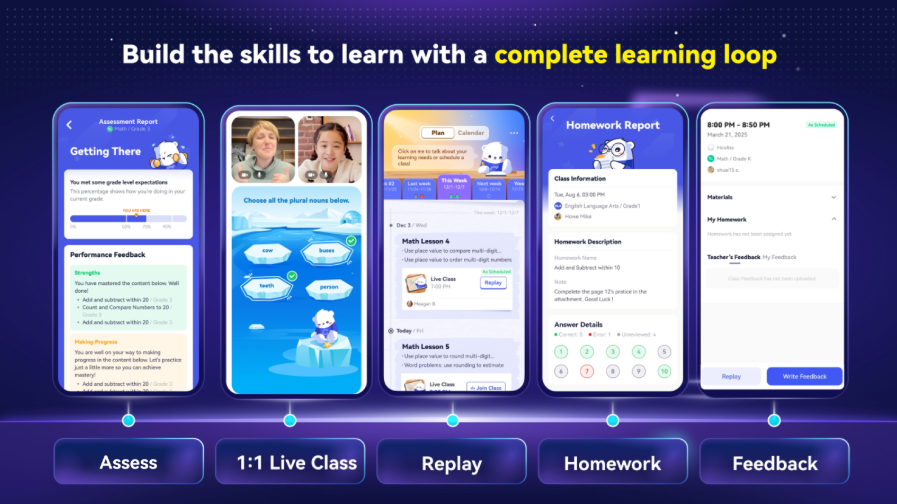
How Cosmo answers this: Cosmo is built around exactly this. Every class is recorded and available in the app, so you can rewatch any session. You can see the materials used in class, read your teacher's written feedback after each session, and get a monthly learning report. Students also take a monthly assessment as a check-in, so progress is something you can actually see and not just hope for.
These parents understood something: you're not buying classes, you're buying a feedback loop. If you can't see what was taught, what your child produced, and what changed since last month, you can't tell the difference between real progress and pleasant vibes.
How Cosmo answers this: Cosmo is built around exactly this. Every class is recorded and available in the app, so you can rewatch any session. You can see the materials used in class, read your teacher's written feedback after each session, and get a monthly learning report. Students also take a monthly assessment as a check-in, so progress is something you can actually see and not just hope for.
"How Much Homework Will There Be?"
A third-grade mom drew her line carefully: "I don't want her whole summer to be just doing homework… I'm probably looking for some, but not a lot. Minimal — just something she can do on her own time."
That's not a soft parent talking — that's good instructional instinct. For elementary kids, short, frequent, independent practice consolidates skills without poisoning the well. A program that assigns the same load to a 2nd grader in July and a 10th grader before the SAT isn't personalizing much of anything.
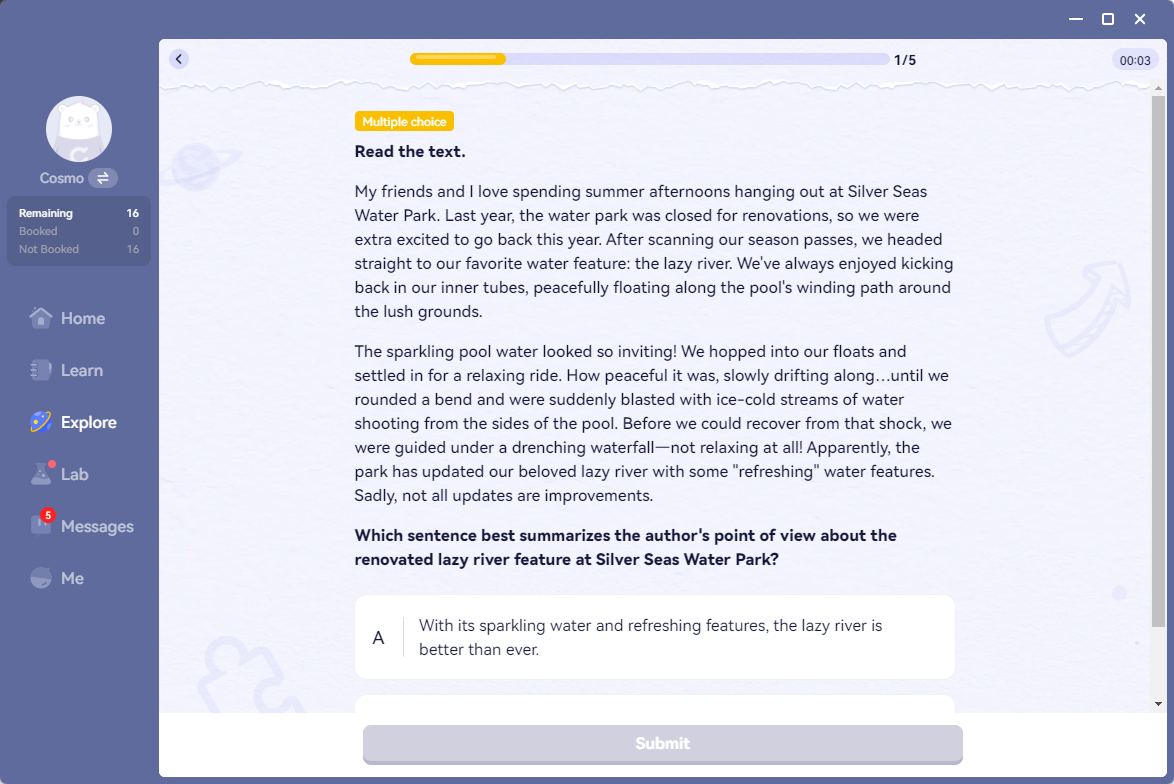
How Cosmo answers this: Teachers assign homework after each session, and you're in control of the amount. Just tell the teacher if you'd like more, less, or none. Each class comes with one homework assignment, but if your child wants extra, the app's Practice feature has more on demand. There's also an AI writing coach: your child can snap a photo of an essay they've written and get instant feedback on it.
That's not a soft parent talking — that's good instructional instinct. For elementary kids, short, frequent, independent practice consolidates skills without poisoning the well. A program that assigns the same load to a 2nd grader in July and a 10th grader before the SAT isn't personalizing much of anything.
How Cosmo answers this: Teachers assign homework after each session, and you're in control of the amount. Just tell the teacher if you'd like more, less, or none. Each class comes with one homework assignment, but if your child wants extra, the app's Practice feature has more on demand. There's also an AI writing coach: your child can snap a photo of an essay they've written and get instant feedback on it.
The Money Questions Are Smart Questions
Parents asked about payment plans, about exactly what a package covers, about family discounts. One mother of several kids was refreshingly blunt: "I didn't realize it was going to be this expensive… I have multiple children. I would like all of them to participate." Another asked about applying a state scholarship to tutoring.
None of this is being cheap. It's being a competent buyer of a service with real variance in value. Here's how it works at Cosmo.
• What the package includes: all the classes under your purchase, plus full access to the app's other learning features (Practice, AI writing coach, recordings, reports).
• Unused classes: credits aren't refundable, but they're valid for a full year from your purchase date.
• Pausing: you can pause any time — just use your credits within the year.
• Siblings: credits can be shared among siblings in the same household.
• Payment plans: available through PayPal, Klarna, and Affirm — split into four interest-free payments if you qualify.
• Discounts: there's no multi-child discount, but if a sibling wants to try Cosmo, their first long-term class is on us.
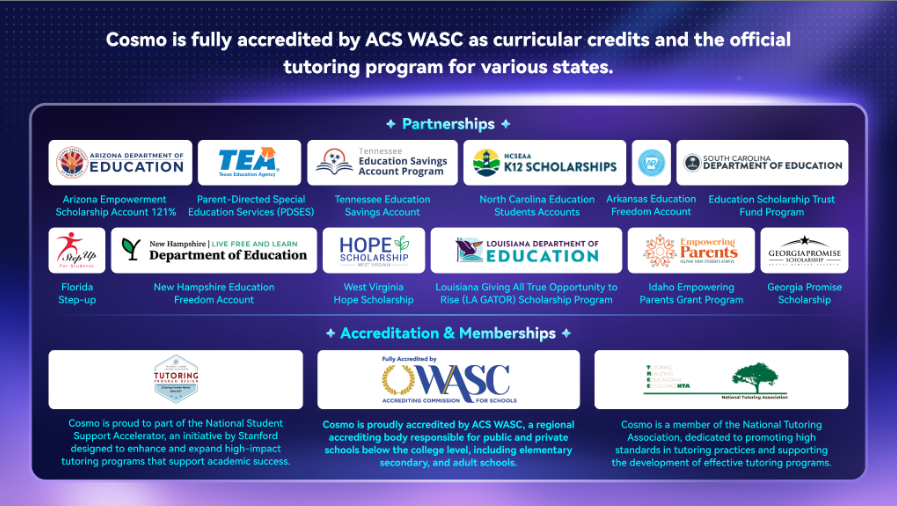
• Scholarships & ESA funds: Cosmo is an approved vendor for 15 states' education savings accounts. If you have something like Florida's Step Up scholarship or an Arizona ESA, you can purchase a Cosmo lesson package directly through your scholarship portal.
None of this is being cheap. It's being a competent buyer of a service with real variance in value. Here's how it works at Cosmo.
• What the package includes: all the classes under your purchase, plus full access to the app's other learning features (Practice, AI writing coach, recordings, reports).
• Unused classes: credits aren't refundable, but they're valid for a full year from your purchase date.
• Pausing: you can pause any time — just use your credits within the year.
• Siblings: credits can be shared among siblings in the same household.
• Payment plans: available through PayPal, Klarna, and Affirm — split into four interest-free payments if you qualify.
• Discounts: there's no multi-child discount, but if a sibling wants to try Cosmo, their first long-term class is on us.
• Scholarships & ESA funds: Cosmo is an approved vendor for 15 states' education savings accounts. If you have something like Florida's Step Up scholarship or an Arizona ESA, you can purchase a Cosmo lesson package directly through your scholarship portal.
When a Trial Class Is the Right Next Step
If you've been going back and forth for weeks — reading reviews, comparing options, asking other parents — at some point the spreadsheet stops helping. The fastest way to evaluate a tutor is to watch one teach your actual child for 50 minutes. That's why the first class at Cosmo is free: it's the real test.
Everything above — the same teacher every session, a plan built from your child's own assessment, recordings and reports you can actually see, homework sized to your kid — is the standard we hold ourselves to. The best way to check whether we live up to it is 50 minutes with the right teacher. Cosmo's first trial class is free. No commitment, no pressure, just a real picture of where your child is. Missed Part 1? Read why kids struggle with writing and the reading connection most families overlook.
Everything above — the same teacher every session, a plan built from your child's own assessment, recordings and reports you can actually see, homework sized to your kid — is the standard we hold ourselves to. The best way to check whether we live up to it is 50 minutes with the right teacher. Cosmo's first trial class is free. No commitment, no pressure, just a real picture of where your child is. Missed Part 1? Read why kids struggle with writing and the reading connection most families overlook.