Summer Project-Based Learning: A Grade-by-Grade Guide for Parents
May 29, 2026
It's the last week of school. Your child comes home with a backpack full of crumpled papers to recycle and the biggest smile you've seen since winter break. Summer is finally here, and be honest, some part of you is thrilled too.
But somewhere in the back of your mind, a quieter thought creeps in: "What happens to everything they just learned?"
If you've watched your child struggle in September — staring blankly at multiplication facts they could rattle off in June, or writing sentences that feel two grades below where they finished — you already know the answer. The summer slide is real, it's frustrating, and it doesn't care how hard your family worked all year.
The good news is that you don't need to turn your living room into a classroom to stop it. One approach that's gaining traction with educators is project-based learning (PBL) and it's built for summer. Here's what it is, why it works, and exactly what it can look like for your child, whether they're in 1st grade or 11th.
But somewhere in the back of your mind, a quieter thought creeps in: "What happens to everything they just learned?"
If you've watched your child struggle in September — staring blankly at multiplication facts they could rattle off in June, or writing sentences that feel two grades below where they finished — you already know the answer. The summer slide is real, it's frustrating, and it doesn't care how hard your family worked all year.
The good news is that you don't need to turn your living room into a classroom to stop it. One approach that's gaining traction with educators is project-based learning (PBL) and it's built for summer. Here's what it is, why it works, and exactly what it can look like for your child, whether they're in 1st grade or 11th.
What Is the Summer Slide — and How Bad Can It Get?
The summer slide refers to the academic knowledge students lose during the summer months when they're out of school. After spending roughly nine months in class, most kids have two to three months without structured learning, and that gap takes a toll.
Research consistently shows that students can lose up to 30% of the knowledge they gained during the school year over a single summer.
Think about that number for a minute. A 30% loss means that of the nine months your child spent in school, three of them could effectively vanish before September's first bell rings. Reading fluency drops. Math facts blur. Writing that was reaching for paragraphs collapses back into simple sentences.
And here's the part parents often miss: you don't need a full school-day schedule to stop it. Even 20 to 30 minutes of intentional, engaging activity each day can dramatically reduce summer slide. The key word is intentional — not worksheets, necessarily, but learning that connects to something your child actually cares about.
Research consistently shows that students can lose up to 30% of the knowledge they gained during the school year over a single summer.
Think about that number for a minute. A 30% loss means that of the nine months your child spent in school, three of them could effectively vanish before September's first bell rings. Reading fluency drops. Math facts blur. Writing that was reaching for paragraphs collapses back into simple sentences.
And here's the part parents often miss: you don't need a full school-day schedule to stop it. Even 20 to 30 minutes of intentional, engaging activity each day can dramatically reduce summer slide. The key word is intentional — not worksheets, necessarily, but learning that connects to something your child actually cares about.
What Is Project-Based Learning — and Why Does It Work?
Project-based learning (PBL) is exactly what it sounds like: kids learn by doing something, rather than by reading a textbook or filling in blanks on a worksheet. The child picks a topic they're genuinely curious about, asks a real question about it, researches and explores it, creates something, and then shares or presents what they learned.
It works for a few reasons that go beyond just making summer feel less like school:
• It builds real-world skills such as measurement, budgeting, research, writing, and communication through context kids actually care about. • It increases motivation because the learning has a reason. Kids who resist math in a textbook will calculate profits and losses happily when it's connected to a business they invented. • It develops critical thinking and independent problem solving — which, according to the National Association of Colleges and Employers' 2025 Job Outlook survey, is the single most sought-after skill employers are looking for in new hires. That last point matters more than it might seem. Employers aren't just hiring degrees, they're hiring people who can look at an unfamiliar problem and figure it out. Summer is an unusually good time to practice just that.
It works for a few reasons that go beyond just making summer feel less like school:
• It builds real-world skills such as measurement, budgeting, research, writing, and communication through context kids actually care about. • It increases motivation because the learning has a reason. Kids who resist math in a textbook will calculate profits and losses happily when it's connected to a business they invented. • It develops critical thinking and independent problem solving — which, according to the National Association of Colleges and Employers' 2025 Job Outlook survey, is the single most sought-after skill employers are looking for in new hires. That last point matters more than it might seem. Employers aren't just hiring degrees, they're hiring people who can look at an unfamiliar problem and figure it out. Summer is an unusually good time to practice just that.
The PBL Framework: Four Simple Steps
Before getting into grade-specific ideas, here's the underlying structure that makes a project actually stick:
• Ask a big question. Start with something your child genuinely wonders about: "How do plants grow?" "What would I need to start a business?" "What does a day in the life of a video game designer look like?" • Research and explore. Books, documentaries, YouTube videos, library trips, interviews with real people — any of these count. • Create something. A garden. A recipe. A resume. A short video. A comic book. Something tangible that shows they engaged with the question. • Share or present what they learned. This can be as low-key as a phone call to grandma or as ambitious as a short video they share with friends. The goal is for them to explain it out loud because research shows that's where the learning really locks in. The whole thing doesn't need to be perfect. It just needs to be consistent. Twenty minutes of this a day is more valuable than four hours of worksheets one random Tuesday.
• Ask a big question. Start with something your child genuinely wonders about: "How do plants grow?" "What would I need to start a business?" "What does a day in the life of a video game designer look like?" • Research and explore. Books, documentaries, YouTube videos, library trips, interviews with real people — any of these count. • Create something. A garden. A recipe. A resume. A short video. A comic book. Something tangible that shows they engaged with the question. • Share or present what they learned. This can be as low-key as a phone call to grandma or as ambitious as a short video they share with friends. The goal is for them to explain it out loud because research shows that's where the learning really locks in. The whole thing doesn't need to be perfect. It just needs to be consistent. Twenty minutes of this a day is more valuable than four hours of worksheets one random Tuesday.
What This Looks Like by Grade Level
Grades 1–3: Focus on Curiosity
At this age, the goal isn't output, it's wonder. You want to channel the questions they're already asking and give them a real way to explore the answers. Some ideas that work well:
• Grow something. Plant a seed in a repurposed egg carton, measure it weekly, and log the results. You're sneaking in measurement, time concepts, handwriting, and science all at once. • Do a kitchen science experiment. Baking soda and vinegar will never get old. Stick celery in food coloring. Then ask the magic follow-up question: "Why did that just happen?" • Play store with real prices. Set up a toy store using items from around the house, then look up their actual prices on Walmart or Amazon. The moment a kid realizes their favorite toy costs $20 is a math lesson that sticks. • Write and illustrate a book. Free comic book templates are available online. Some services will even print and bind a finished copy for a few dollars — a completely disproportionate amount of motivation for a very small investment. Keep sessions to 15–20 minutes. The point is a spark, not a syllabus.
• Grow something. Plant a seed in a repurposed egg carton, measure it weekly, and log the results. You're sneaking in measurement, time concepts, handwriting, and science all at once. • Do a kitchen science experiment. Baking soda and vinegar will never get old. Stick celery in food coloring. Then ask the magic follow-up question: "Why did that just happen?" • Play store with real prices. Set up a toy store using items from around the house, then look up their actual prices on Walmart or Amazon. The moment a kid realizes their favorite toy costs $20 is a math lesson that sticks. • Write and illustrate a book. Free comic book templates are available online. Some services will even print and bind a finished copy for a few dollars — a completely disproportionate amount of motivation for a very small investment. Keep sessions to 15–20 minutes. The point is a spark, not a syllabus.
Grades 4–6: Focus on Problem Solving and Independence
Kids in this range are ready to take ownership of a project with a little scaffolding. This is a great age to introduce entrepreneurship.
One Cosmo teacher recently described how her fifth-grade son used the summer to launch a homemade Play-Doh stand. He had to list every ingredient, calculate the cost per batch, and figure out how much he'd need to charge to actually make a profit. He hates math in a textbook. He did this math cheerfully for weeks because it was his project and his money.
• Start a small business. Make and sell stickers, greeting cards, or simple crafts. Even if it's just for family and neighbors, the budgeting, pricing, and writing involved is substantial. • Plan a virtual trip. Pick a country they want to visit someday. Research the food, learn five phrases in the language, cook a copycat recipe, take a Google Maps street-view tour, and write a journal entry. Geography, writing, and world culture in one project. • Teach a skill to someone younger. Whether it's a sibling, neighbor kid, or cousin, explaining something you know forces a different level of understanding than just knowing it yourself. • Cook one meal a week independently. Even frozen chicken nuggets counts! The reading comprehension, measurement, and time management involved in following a recipe — or writing their own — is real academic practice. At this age, the "present it" step matters a lot. Have them share what they learned at the end. Even a phone call to a grandparent where they explain the project builds communication skills most schools don't have time to teach.
One Cosmo teacher recently described how her fifth-grade son used the summer to launch a homemade Play-Doh stand. He had to list every ingredient, calculate the cost per batch, and figure out how much he'd need to charge to actually make a profit. He hates math in a textbook. He did this math cheerfully for weeks because it was his project and his money.
• Start a small business. Make and sell stickers, greeting cards, or simple crafts. Even if it's just for family and neighbors, the budgeting, pricing, and writing involved is substantial. • Plan a virtual trip. Pick a country they want to visit someday. Research the food, learn five phrases in the language, cook a copycat recipe, take a Google Maps street-view tour, and write a journal entry. Geography, writing, and world culture in one project. • Teach a skill to someone younger. Whether it's a sibling, neighbor kid, or cousin, explaining something you know forces a different level of understanding than just knowing it yourself. • Cook one meal a week independently. Even frozen chicken nuggets counts! The reading comprehension, measurement, and time management involved in following a recipe — or writing their own — is real academic practice. At this age, the "present it" step matters a lot. Have them share what they learned at the end. Even a phone call to a grandparent where they explain the project builds communication skills most schools don't have time to teach.
Grades 7–9: Focus on Critical Thinking and Real-World Complexity
Middle schoolers are often more capable than they act. This is a good time to stop protecting them from complexity and start inviting them into it.
• Debate a real-world issue. Pick a current event, a piece of history they find interesting, or even a family rule they'd like to change. The constraint: they have to come with reasons, not just opinions. Ask "Where did you get that information?" and "How do you know that source is reliable?" • Design and sell digital products. Stickers, printable planners, and digital art can be sold online through several free or almost-free platforms. This age group can realistically manage the entire process, from creation to marketing to customer communication. • Start a podcast with a friend. Even if it only ever gets shared within a private family group, planning episodes, researching topics, and recording themselves speaking clearly is exactly the kind of communication practice schools rarely have time for. • Build something with code. There are free beginner courses that will take a motivated 7th grader from zero to a working mini-game in a few weeks. One Cosmo teacher's 12-year-old built a playable video game this way without any adult help after the first tutorial. The key with this age group: ask guiding questions, but don't give answers. "What do you think?" and "What would you do differently?" go further than any explanation you could give.
• Debate a real-world issue. Pick a current event, a piece of history they find interesting, or even a family rule they'd like to change. The constraint: they have to come with reasons, not just opinions. Ask "Where did you get that information?" and "How do you know that source is reliable?" • Design and sell digital products. Stickers, printable planners, and digital art can be sold online through several free or almost-free platforms. This age group can realistically manage the entire process, from creation to marketing to customer communication. • Start a podcast with a friend. Even if it only ever gets shared within a private family group, planning episodes, researching topics, and recording themselves speaking clearly is exactly the kind of communication practice schools rarely have time for. • Build something with code. There are free beginner courses that will take a motivated 7th grader from zero to a working mini-game in a few weeks. One Cosmo teacher's 12-year-old built a playable video game this way without any adult help after the first tutorial. The key with this age group: ask guiding questions, but don't give answers. "What do you think?" and "What would you do differently?" go further than any explanation you could give.
Grades 10–12: Focus on Career Exploration and Real Readiness
High schoolers are genuinely close to adulthood, but most of them have a much fuzzier picture of what that actually means than they let on. Summer is an unusually good time to sharpen that picture.
• Shadow someone in a career they're curious about. Call up anyone in your network with a different job than yours and ask if your teenager can spend a day with them. Even an hourlong coffee conversation where they get to ask real questions is more grounding than any career assessment quiz. • Write a real resume. Not a practice one, an actual resume that documents their real experience, skills, and interests. The act of articulating what they've done forces clarity about what they want to do. • Research the actual pathway to a career they're considering. What degree, trade certification, or apprenticeship does it require? What does a starting salary look like versus ten years in? What did people in that field actually study? • Create something they could show a college or employer. A short film, a design portfolio, a blog about a topic they know well, or even a polished journal of the summer's project. Demonstrating initiative and follow-through is something most other applicants won't have. The goal at this stage is to give them the experience of trying something and running into the gap between what they thought it would be and what it actually is. That gap is where real preparation happens.
• Shadow someone in a career they're curious about. Call up anyone in your network with a different job than yours and ask if your teenager can spend a day with them. Even an hourlong coffee conversation where they get to ask real questions is more grounding than any career assessment quiz. • Write a real resume. Not a practice one, an actual resume that documents their real experience, skills, and interests. The act of articulating what they've done forces clarity about what they want to do. • Research the actual pathway to a career they're considering. What degree, trade certification, or apprenticeship does it require? What does a starting salary look like versus ten years in? What did people in that field actually study? • Create something they could show a college or employer. A short film, a design portfolio, a blog about a topic they know well, or even a polished journal of the summer's project. Demonstrating initiative and follow-through is something most other applicants won't have. The goal at this stage is to give them the experience of trying something and running into the gap between what they thought it would be and what it actually is. That gap is where real preparation happens.
The Misconception That Makes Summer Learning Harder
Many parents assume that to prevent the summer slide, they need to replicate the school day — same hours, same structure, same format. So they either try to do it (and burn out by week two) or feel guilty for not doing it.
The research doesn't support this. Learning doesn't need to look like school to be effective. In fact, some of the most effective learning doesn't look like school at all. A kid who spends the summer running a small business, cooking meals independently, interviewing adults about their careers, and finishing a project they built themselves will return to school in September with stronger skills than one who spent the summer doing workbooks.
What matters is that it's consistent, connected to something they care about, and just challenging enough that they have to think.
The research doesn't support this. Learning doesn't need to look like school to be effective. In fact, some of the most effective learning doesn't look like school at all. A kid who spends the summer running a small business, cooking meals independently, interviewing adults about their careers, and finishing a project they built themselves will return to school in September with stronger skills than one who spent the summer doing workbooks.
What matters is that it's consistent, connected to something they care about, and just challenging enough that they have to think.
When Summer Learning Isn't Enough on Its Own
For many kids, project-based learning over the summer is exactly what they need. It keeps the brain active, builds confidence, and makes September feel like a continuation rather than a restart.
But if your child ended the year significantly behind in a core subject like reading or math, a summer of projects alone may not close that gap. If any of the following sound familiar, it may be worth adding structured support alongside the project work:
• They're more than one grade level behind in reading or math according to their teacher or report card. • They struggled to complete grade-level assignments even with help at home throughout the school year. • They're heading into a high-stakes transition — entering middle school, high school, or preparing for the SAT — and you're genuinely uncertain whether they're ready. In these cases, focused sessions with a tutor who can identify the specific skill gap can make a real difference. The combination of targeted skill-building and open-ended project learning tends to work better than either one alone.
But if your child ended the year significantly behind in a core subject like reading or math, a summer of projects alone may not close that gap. If any of the following sound familiar, it may be worth adding structured support alongside the project work:
• They're more than one grade level behind in reading or math according to their teacher or report card. • They struggled to complete grade-level assignments even with help at home throughout the school year. • They're heading into a high-stakes transition — entering middle school, high school, or preparing for the SAT — and you're genuinely uncertain whether they're ready. In these cases, focused sessions with a tutor who can identify the specific skill gap can make a real difference. The combination of targeted skill-building and open-ended project learning tends to work better than either one alone.
How Cosmo Can Help
At Cosmo, summer programs are designed around exactly the kind of thinking project-based learning builds on. Our teachers don't just review what your child learned last year. They work to identify where understanding actually broke down and rebuild it from there.
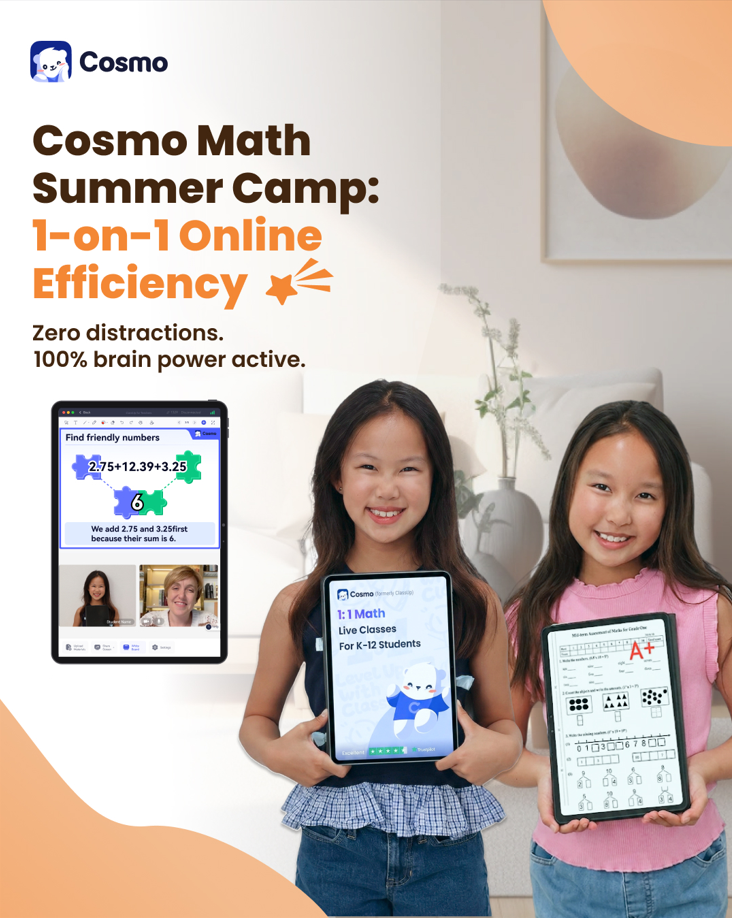
Every class is live, one-on-one, and taught by a teacher who knows your child's specific learning profile. That means if your 5th grader has a real grasp of addition and subtraction but hasn't truly made sense of fractions yet, that's where their summer work actually starts — not at a generic "Grade 5 review."
The first class is free and it's a real diagnostic session with a real teacher. You'll walk away with a clearer picture of where your child is than most report cards will give you. Combine that with a summer full of projects they're excited about, and September looks a lot different. Book a free class →
Every class is live, one-on-one, and taught by a teacher who knows your child's specific learning profile. That means if your 5th grader has a real grasp of addition and subtraction but hasn't truly made sense of fractions yet, that's where their summer work actually starts — not at a generic "Grade 5 review."
The first class is free and it's a real diagnostic session with a real teacher. You'll walk away with a clearer picture of where your child is than most report cards will give you. Combine that with a summer full of projects they're excited about, and September looks a lot different. Book a free class →