
3rd Grade Reading Comprehension: How Lily Went from Struggling to Analyzing Stories in 10 Classes
June 05, 2026
I'm Mr. Aaron, an English Language Arts teacher at Cosmo. In my years of teaching, I've worked with a lot of third graders who could read every word on the page, but still couldn't tell me what the story was about. Lily was one of them.
The First Class
The first time Lily read to me, she did it well. She kept a steady pace, sounded out words she didn't know, and moved through the passage without much hesitation. Then I asked her a question about it.
We were looking at a short excerpt from The One and Only Ivan — a story told from the perspective of a gorilla named Ivan. The question asked what Ivan meant when he said "humans waste words." Lily had read the sentence. She had the answer choices right in front of her. But when I asked her to explain her thinking, she paused for a long time.
"What do you think?" I asked. "Take a look at the answers again."
After another moment: "Humans don't use their words wisely?"
"Yes — and what makes you say that?"
More silence. Not because she wasn't trying. She just didn't have the words yet to explain why something was true in a text. She could arrive at the right destination; she just couldn't describe the route she took to get there. That's a very specific gap — and it's one of the most common things I see at the start of third grade.
We were looking at a short excerpt from The One and Only Ivan — a story told from the perspective of a gorilla named Ivan. The question asked what Ivan meant when he said "humans waste words." Lily had read the sentence. She had the answer choices right in front of her. But when I asked her to explain her thinking, she paused for a long time.
"What do you think?" I asked. "Take a look at the answers again."
After another moment: "Humans don't use their words wisely?"
"Yes — and what makes you say that?"
More silence. Not because she wasn't trying. She just didn't have the words yet to explain why something was true in a text. She could arrive at the right destination; she just couldn't describe the route she took to get there. That's a very specific gap — and it's one of the most common things I see at the start of third grade.
Why "Getting It" Isn't the Same as Understanding It
Third grade is where reading shifts from a mechanical skill to an analytical one. Before Grade 3, students are largely learning to decode — to match letters to sounds and build words. Starting around Grade 3, the expectation flips: students are now supposed to use reading to learn, not just demonstrate that they can read. That transition is harder than it sounds.
The 2024 NAEP reading assessment found that only 31% of fourth-grade students performed at or above the Proficient level, and that number has been declining since 2019. What that data doesn't show is why so many students plateau. In my experience, it's rarely a decoding problem by this stage. It's the jump to inference — reading between the lines, connecting a character's actions to a theme, understanding that a text can mean something beyond its literal words.
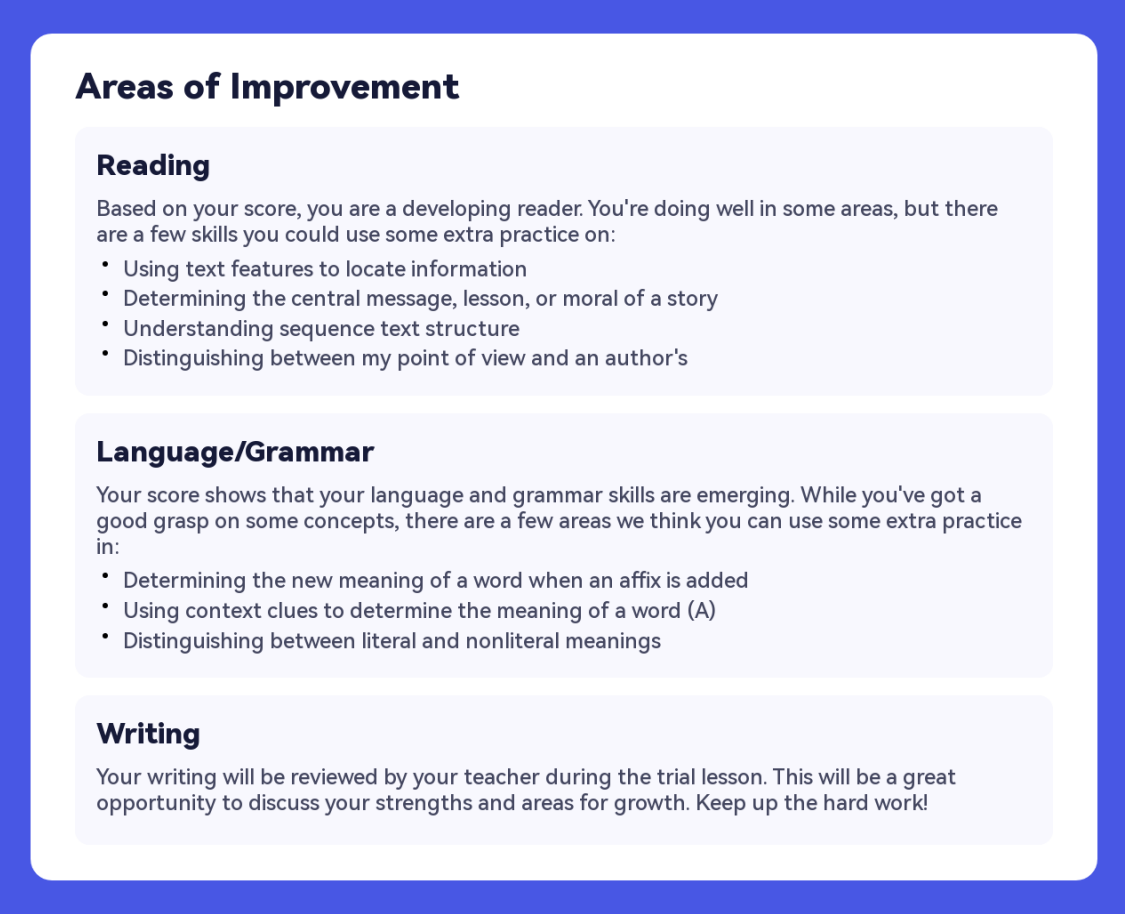
Lily's diagnostic assessment confirmed this. She was working toward grade-level expectations. She wasn't far behind, but not yet at the point where reading comprehension clicked on its own. Her specific gaps: determining the central message of a story, understanding sequence in text structure, and distinguishing her own point of view from the author's. Skills that no amount of reading fluency practice will fix on their own.
The 2024 NAEP reading assessment found that only 31% of fourth-grade students performed at or above the Proficient level, and that number has been declining since 2019. What that data doesn't show is why so many students plateau. In my experience, it's rarely a decoding problem by this stage. It's the jump to inference — reading between the lines, connecting a character's actions to a theme, understanding that a text can mean something beyond its literal words.
Lily's diagnostic assessment confirmed this. She was working toward grade-level expectations. She wasn't far behind, but not yet at the point where reading comprehension clicked on its own. Her specific gaps: determining the central message of a story, understanding sequence in text structure, and distinguishing her own point of view from the author's. Skills that no amount of reading fluency practice will fix on their own.
What It Actually Looked Like in Our Sessions
In that first class, Lily could read the learning goals aloud, but she stumbled on words like "motivations" and "characteristics." Not because she was a poor reader, but because she hadn't encountered those words in context before. She knew the syllables when we broke them down together. She just needed someone to slow down with her instead of pushing on past.
I noticed something else that day: Lily draws. She mentioned it casually when I asked about her hobbies. I filed that away. Students who draw usually have strong visual processing, which means they can build mental images from text. That's a real asset for comprehension work, if you know how to use it.
By our fourth class, Lily was submitting written homework responses with complete paragraphs summarizing story events. The ideas were there. The grammar was still developing: she was working through homophones like there/their/they're, learning when to capitalize proper nouns, getting used to proofreading her own work one category at a time. She was doing the right things. She just needed consistency and someone who noticed the difference between a grammar problem and a comprehension problem.
I noticed something else that day: Lily draws. She mentioned it casually when I asked about her hobbies. I filed that away. Students who draw usually have strong visual processing, which means they can build mental images from text. That's a real asset for comprehension work, if you know how to use it.
By our fourth class, Lily was submitting written homework responses with complete paragraphs summarizing story events. The ideas were there. The grammar was still developing: she was working through homophones like there/their/they're, learning when to capitalize proper nouns, getting used to proofreading her own work one category at a time. She was doing the right things. She just needed consistency and someone who noticed the difference between a grammar problem and a comprehension problem.
The Moment Something Shifted
It happened around our sixth class. We were reading stories from diverse cultures — fables, folktales, myths — and Lily was working through "The Fox and the Grapes," an Aesop fable. She read the whole thing aloud, then I asked her what the fox was really feeling at the end of the story.
She thought about it. "He's… pretending he didn't want them?"
"Right — and what do we call that, when someone pretends they didn't want the thing they couldn't get?"
She thought for another second. Then: "Sour grapes?"
She had read the phrase in the text. But now she was using it to explain behavior — her own interpretation, not just a repeated definition. That's the leap. I almost didn't push on it, because the moment happened so quickly. But it mattered.
She thought about it. "He's… pretending he didn't want them?"
"Right — and what do we call that, when someone pretends they didn't want the thing they couldn't get?"
She thought for another second. Then: "Sour grapes?"
She had read the phrase in the text. But now she was using it to explain behavior — her own interpretation, not just a repeated definition. That's the leap. I almost didn't push on it, because the moment happened so quickly. But it mattered.
Where She Is Now
By our tenth class, Lily was reading a passage from Magic Tree House aloud. Fluently. She read through a prehistoric landscape, a T-Rex roar, Annie's confident smile. She was tracking character feelings and actions as she went. When I asked how Jack felt while gripping his backpack tightly near the dinosaurs, she connected the physical action to an emotion without me even scaffolding the question.
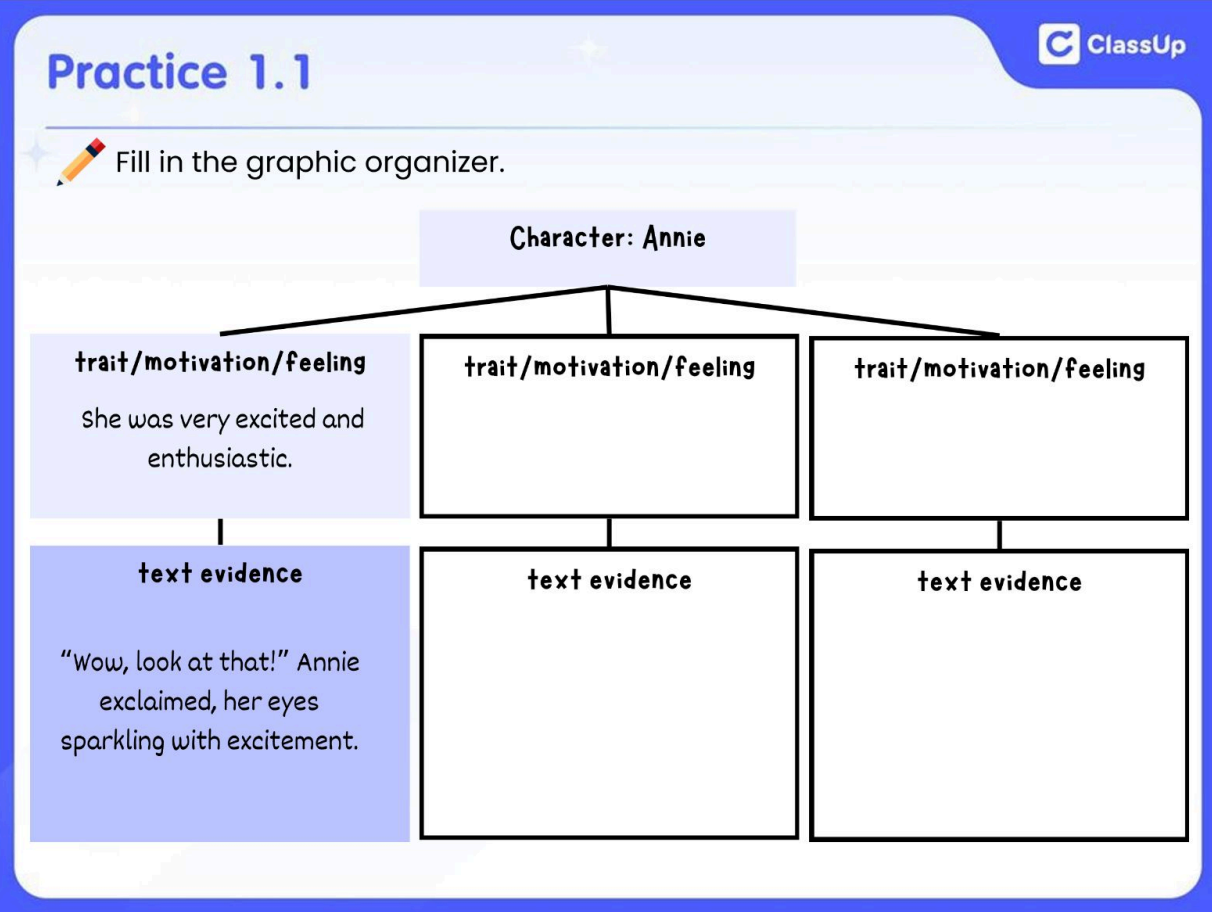
She's now working on identifying character traits using text evidence, writing those observations in full sentences, and understanding the difference between what a character wants (motivation) and who they are (trait). These are Grade 3 standards — the ones that predict reading success all the way through middle school.
She also typed her own text evidence into a graphic organizer that day. I asked if she'd been practicing her typing. "Yes," she said. That mattered too.
At the end of class, I told her she was doing great. She said "Yay!" — and I believed she meant it.
She's now working on identifying character traits using text evidence, writing those observations in full sentences, and understanding the difference between what a character wants (motivation) and who they are (trait). These are Grade 3 standards — the ones that predict reading success all the way through middle school.
She also typed her own text evidence into a graphic organizer that day. I asked if she'd been practicing her typing. "Yes," she said. That mattered too.
At the end of class, I told her she was doing great. She said "Yay!" — and I believed she meant it.
What I've Learned Watching Students Like Lily
The hardest thing to explain to parents is that reading comprehension doesn't improve on a straight line. A student can be "behind" on a diagnostic and then, inside a single conversation about a fox and some grapes, suddenly demonstrate the exact skill the assessment said she was missing. It doesn't mean the assessment was wrong. It means comprehension is a practice. It's something that develops through repeated exposure to good questions and patient redirection, not through drilling worksheets.
What Lily needed wasn't a different curriculum. She needed someone to ask the right question at the right moment, and then wait long enough for her to answer it herself.
What Lily needed wasn't a different curriculum. She needed someone to ask the right question at the right moment, and then wait long enough for her to answer it herself.
What You Can Do at Home This Week
If you're watching your third grader read fluently but struggle to discuss what they read, here are a few things to try:
1. Ask "what do you think [character] was feeling when…" instead of "what happened next."
Feeling questions require inference. Plot questions can often be answered by pointing to a sentence.
2. After reading a chapter, ask your child to draw one scene from it.
Then ask them to explain what's happening in their drawing. Drawing forces visualization — which is the same mental process as comprehension.
3. Try the "so what?" question.
After your child tells you what happened in a story, ask: "So what does that mean? Why does that matter?" You're teaching them to move from plot to meaning — the core of Grade 3 reading.
4. When your child reads something wrong or gets stuck, resist the urge to immediately correct.
Count to five. Give them a chance to self-correct. That pause is where learning happens.
1. Ask "what do you think [character] was feeling when…" instead of "what happened next."
Feeling questions require inference. Plot questions can often be answered by pointing to a sentence.
2. After reading a chapter, ask your child to draw one scene from it.
Then ask them to explain what's happening in their drawing. Drawing forces visualization — which is the same mental process as comprehension.
3. Try the "so what?" question.
After your child tells you what happened in a story, ask: "So what does that mean? Why does that matter?" You're teaching them to move from plot to meaning — the core of Grade 3 reading.
4. When your child reads something wrong or gets stuck, resist the urge to immediately correct.
Count to five. Give them a chance to self-correct. That pause is where learning happens.
What to Look for in a Tutor (From Someone Who Is One)
Lily put it better than I could, in a note she sent recently: "Mr. Aaron helps me understand the question, helps me go back into the story to answer the questions and helps me to improve my reading. He tells me what to work on so I can get better at reading. He makes learning fun."
That's what I try to do in every class I teach at Cosmo. If it sounds like what your child needs, I'd say come try a session — the first one is free.
That's what I try to do in every class I teach at Cosmo. If it sounds like what your child needs, I'd say come try a session — the first one is free.