
My 3rd Grader Wrote One Sentence. Is That Normal?
June 05, 2026
A few weeks ago, I asked a student to read me what he'd written on his Cosmo assessment. The prompt was: Should kids have chores at home?
He read: "Kids should have chores that help so they can help their parents around the house."
One sentence. He looked at me, clearly satisfied. I told him it was a great sentence and I meant it. Then I said we were going to turn it into something that sounded like a real paragraph.
I'm Lisa, an ELA teacher at Cosmo. I work with 3rd graders almost every day, and getting only one, perfectly good, sentence where a paragraph should be is incredibly common. If your child does the same thing, here's what I want you to know.
He read: "Kids should have chores that help so they can help their parents around the house."
One sentence. He looked at me, clearly satisfied. I told him it was a great sentence and I meant it. Then I said we were going to turn it into something that sounded like a real paragraph.
I'm Lisa, an ELA teacher at Cosmo. I work with 3rd graders almost every day, and getting only one, perfectly good, sentence where a paragraph should be is incredibly common. If your child does the same thing, here's what I want you to know.
Is my 3rd grader behind if they only write one sentence?
Probably not behind, but they are at the exact point where writing gets hard in a new way.
In 2nd grade, the goal was mostly sentence-level: write complete sentences, use capital letters and punctuation. By 3rd grade, Common Core expects something much more robust: a full opinion paragraph with a clear position, two to three reasons connected with linking words, and a conclusion. That's an enormous jump, and it happens fast.
So the one-sentence writer isn't struggling because something went wrong. They're struggling because the standard just made a leap that nobody told them about.
When Cosmo looked at assessment results from the most recent 100 Grade 3 ELA students, every single one of them — all 100 — scored "emerging" in writing. Not most. All of them. Kids who scored 87% overall on their G3 ELA grade level expectations. Kids who scored 37%. Writing was the universal gap.
In 2nd grade, the goal was mostly sentence-level: write complete sentences, use capital letters and punctuation. By 3rd grade, Common Core expects something much more robust: a full opinion paragraph with a clear position, two to three reasons connected with linking words, and a conclusion. That's an enormous jump, and it happens fast.
So the one-sentence writer isn't struggling because something went wrong. They're struggling because the standard just made a leap that nobody told them about.
When Cosmo looked at assessment results from the most recent 100 Grade 3 ELA students, every single one of them — all 100 — scored "emerging" in writing. Not most. All of them. Kids who scored 87% overall on their G3 ELA grade level expectations. Kids who scored 37%. Writing was the universal gap.
My child is a good reader. Why can't they write?
This is the question I hear most often, and it trips people up because reading and writing feel like they should be the same skill. They're not.
Reading is receiving a structure that someone else built. Writing is building that structure yourself, from nothing, while also generating ideas, choosing words, and managing punctuation. For an 8-year-old, that's a lot of cognitive work happening simultaneously.
What makes it harder is that most 3rd graders have never been explicitly shown that a paragraph has a shape. They know what a paragraph looks like when they read one, but maybe they've never had anyone say: this thing has a beginning whose job is to grab attention, a middle whose job is to give reasons, and an ending whose job is to leave the reader with something. Without that map, even a strong reader is writing blind.
The Cosmo assessment data backs this up. The most common three reading gaps across those 100 students' diagnostic assessments were: identifying the main idea of an informational text, understanding sequence and text structure, and distinguishing literal from nonliteral language. These look like reading problems. They're also writing problems. A student who can't identify how ideas sequence when reading can't sequence their own reasons when writing. It's the same skill running in opposite directions.
Reading is receiving a structure that someone else built. Writing is building that structure yourself, from nothing, while also generating ideas, choosing words, and managing punctuation. For an 8-year-old, that's a lot of cognitive work happening simultaneously.
What makes it harder is that most 3rd graders have never been explicitly shown that a paragraph has a shape. They know what a paragraph looks like when they read one, but maybe they've never had anyone say: this thing has a beginning whose job is to grab attention, a middle whose job is to give reasons, and an ending whose job is to leave the reader with something. Without that map, even a strong reader is writing blind.
The Cosmo assessment data backs this up. The most common three reading gaps across those 100 students' diagnostic assessments were: identifying the main idea of an informational text, understanding sequence and text structure, and distinguishing literal from nonliteral language. These look like reading problems. They're also writing problems. A student who can't identify how ideas sequence when reading can't sequence their own reasons when writing. It's the same skill running in opposite directions.
My child knows what they want to say — they just won't write it down. What's going on?
That gap between talking and writing is one of the most recognizable things in 3rd grade, and it's not about motivation or laziness. It's about cognitive load.
When a child talks, they're just thinking out loud. The structure emerges naturally from how conversation works. When they write, they suddenly have to manage the structure deliberately: What comes first? How do I connect reason one to reason two? How do I end it? All of that has to happen at the same time as the physical act of writing.
The fix isn't to push harder on the writing. It's to make the structure so automatic that it stops taking up mental energy.
I teach it with an analogy. I tell students their paragraph is like a burger. The top bun is your hook — the opening that pulls someone in before they even take a bite. The layers in the middle are your reasons. The bottom bun holds it all together. That's your conclusion. Once a student can name those three parts and knows what each one does, the writing stops being a scary blank thing and becomes something with a shape they can fill in.
One of my students — the same one who wrote that single sentence — built his burger layer by layer. Hook, three reasons, conclusion. By the end of the class, he'd written a full paragraph and read it back aloud. He stopped mid-sentence and said, almost to himself: "That sounds like a real paragraph." That's the moment. Once a kid hears their own writing land, they believe they can do it again.
When a child talks, they're just thinking out loud. The structure emerges naturally from how conversation works. When they write, they suddenly have to manage the structure deliberately: What comes first? How do I connect reason one to reason two? How do I end it? All of that has to happen at the same time as the physical act of writing.
The fix isn't to push harder on the writing. It's to make the structure so automatic that it stops taking up mental energy.
I teach it with an analogy. I tell students their paragraph is like a burger. The top bun is your hook — the opening that pulls someone in before they even take a bite. The layers in the middle are your reasons. The bottom bun holds it all together. That's your conclusion. Once a student can name those three parts and knows what each one does, the writing stops being a scary blank thing and becomes something with a shape they can fill in.
One of my students — the same one who wrote that single sentence — built his burger layer by layer. Hook, three reasons, conclusion. By the end of the class, he'd written a full paragraph and read it back aloud. He stopped mid-sentence and said, almost to himself: "That sounds like a real paragraph." That's the moment. Once a kid hears their own writing land, they believe they can do it again.
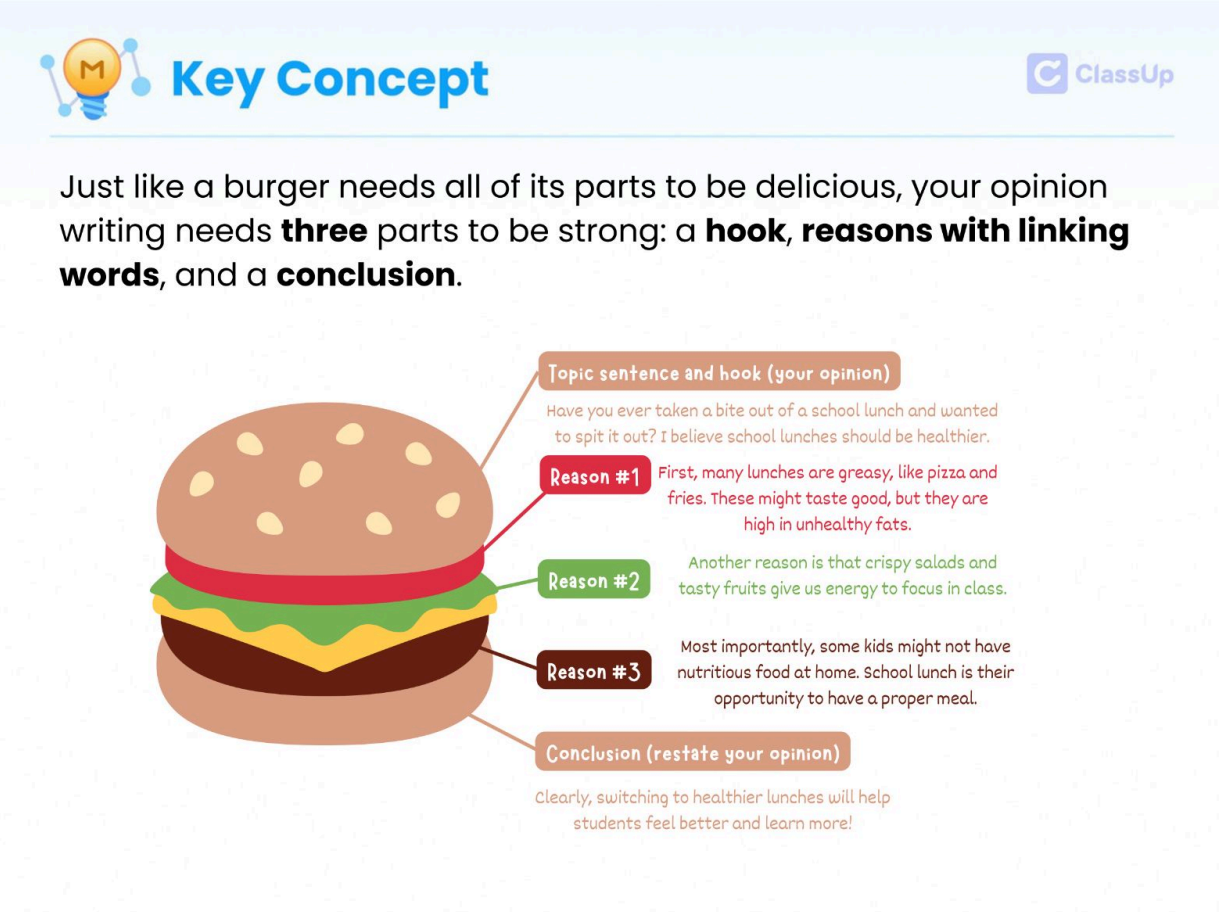
What does 3rd grade opinion writing actually look like when it's going well?
Here's a real example from that same class, built together over about 25 minutes:
"Do you think parents should pay their children for doing chores? I don't think kids should get money for chores. Chores can be fun. Kids spend a lot of time on chores. Parents should save their money for what the family needs. And some kids should do their chores to help their family."
Is it a masterpiece? No. But look at what's there: a question hook, a clear opinion sentence, three distinct reasons, and a conclusion. That's exactly what the standard asks for. That paragraph was built by an 8-year-old who, 20 minutes earlier, had written one sentence and called it done.
The jump isn't as big as it looks — once a student has the structure, they can fill it in. The structure is the hard part, and it's entirely teachable.
"Do you think parents should pay their children for doing chores? I don't think kids should get money for chores. Chores can be fun. Kids spend a lot of time on chores. Parents should save their money for what the family needs. And some kids should do their chores to help their family."
Is it a masterpiece? No. But look at what's there: a question hook, a clear opinion sentence, three distinct reasons, and a conclusion. That's exactly what the standard asks for. That paragraph was built by an 8-year-old who, 20 minutes earlier, had written one sentence and called it done.
The jump isn't as big as it looks — once a student has the structure, they can fill it in. The structure is the hard part, and it's entirely teachable.
What can I actually do at home this week?
Three things, none of which require a worksheet:
1. Ask "what's your hook?" before they write anything.
Before your child puts pen to paper, ask: how are you starting it? A question? A bold statement? A surprising fact? Give them those three options. That one question builds the habit of thinking about the reader first.
2. Do a "three reasons" warmup at dinner.
Pick any low-stakes topic — should we get a dog, should school have recess twice a day — and ask your child for three reasons out loud. When they give two, say: great, one more. This trains the muscle of generating multiple reasons before any writing starts.
3. Have them read their writing out loud before turning it in.
This is the most powerful editing habit I know. When kids hear their writing, they catch missing endings, repeated reasons, and sentences that trail off. Ask: did that sound finished? If they hesitate, it probably needs a conclusion.
1. Ask "what's your hook?" before they write anything.
Before your child puts pen to paper, ask: how are you starting it? A question? A bold statement? A surprising fact? Give them those three options. That one question builds the habit of thinking about the reader first.
2. Do a "three reasons" warmup at dinner.
Pick any low-stakes topic — should we get a dog, should school have recess twice a day — and ask your child for three reasons out loud. When they give two, say: great, one more. This trains the muscle of generating multiple reasons before any writing starts.
3. Have them read their writing out loud before turning it in.
This is the most powerful editing habit I know. When kids hear their writing, they catch missing endings, repeated reasons, and sentences that trail off. Ask: did that sound finished? If they hesitate, it probably needs a conclusion.
When should I get outside help — and what should it look like?
If your child can argue their position clearly in conversation but still can't transfer it to paper after a few weeks of trying, that's the signal. It means the structure hasn't become automatic yet, and that's genuinely hard to fix through traditional classroom instruction alone, where a teacher has 25 other kids to attend to.
Summer is actually the best window to work on this. There's no new material coming, no tests to prepare for — just space to slow down and build the thing that was missing. A student who internalizes the shape of a paragraph before 4th grade starts is in a completely different position than one who doesn't. The writing expectations compound fast: multi-paragraph essays, evidence from texts, writing across genres. Getting ahead of that transition matters.
The same 100-student assessment data that showed 100% emerging in writing also showed significant gaps in identifying main idea and text structure. Those reading and writing gaps tend to move together. Working on both at the same time, with a teacher who treats them as connected, moves the needle faster than treating them separately — and in a 1:1 setting, that kind of targeted work is actually possible.
The most important thing I can tell you about finding the right tutor: the first question they ask should not be "what did you do wrong?" It should be "read me what you wrote, and tell me what you were trying to say." The gap between those two things is where all the real teaching happens.
That's where I start in every Cosmo ELA live session. We look at the assessment together, find exactly where the structure breaks down, and build from there — one real paragraph at a time. If that sounds like what your 3rd grader needs this summer, the first class is free to try!
Summer is actually the best window to work on this. There's no new material coming, no tests to prepare for — just space to slow down and build the thing that was missing. A student who internalizes the shape of a paragraph before 4th grade starts is in a completely different position than one who doesn't. The writing expectations compound fast: multi-paragraph essays, evidence from texts, writing across genres. Getting ahead of that transition matters.
The same 100-student assessment data that showed 100% emerging in writing also showed significant gaps in identifying main idea and text structure. Those reading and writing gaps tend to move together. Working on both at the same time, with a teacher who treats them as connected, moves the needle faster than treating them separately — and in a 1:1 setting, that kind of targeted work is actually possible.
The most important thing I can tell you about finding the right tutor: the first question they ask should not be "what did you do wrong?" It should be "read me what you wrote, and tell me what you were trying to say." The gap between those two things is where all the real teaching happens.
That's where I start in every Cosmo ELA live session. We look at the assessment together, find exactly where the structure breaks down, and build from there — one real paragraph at a time. If that sounds like what your 3rd grader needs this summer, the first class is free to try!