
From Stumped to Solving: How One 5th Grader Finally Conquered Math Word Problems
May 19, 2026
I knew Mila could do the math.
I'm Emi, a math teacher at Cosmo with eleven years in elementary and middle school classrooms. In that time, I've worked with a lot of 5th graders who look exactly like Mila did earlier this year: strong on computation, confident with procedures, and completely stuck the moment a real-world story got wrapped around the numbers.
She had strong number sense. She could work through fraction procedures without much help. Put a computation in front of her — divide these fractions, multiply this mixed number — and she'd get it done. But word problems? That was a different story.
Earlier this year, I watched her read a problem twice, pause, and then look at me with that particular expression I've come to recognize: I see all the words. I just don't know what to do with them. The answer was right there in the problem. She had every skill she needed to find it. But something between reading the sentence and writing the equation just… stopped.
That block, the gap between understanding math and being able to use it, is something I see in a lot of 5th graders. And it took me a few years of teaching to understand why it's not really a math problem at all.
I'm Emi, a math teacher at Cosmo with eleven years in elementary and middle school classrooms. In that time, I've worked with a lot of 5th graders who look exactly like Mila did earlier this year: strong on computation, confident with procedures, and completely stuck the moment a real-world story got wrapped around the numbers.
She had strong number sense. She could work through fraction procedures without much help. Put a computation in front of her — divide these fractions, multiply this mixed number — and she'd get it done. But word problems? That was a different story.
Earlier this year, I watched her read a problem twice, pause, and then look at me with that particular expression I've come to recognize: I see all the words. I just don't know what to do with them. The answer was right there in the problem. She had every skill she needed to find it. But something between reading the sentence and writing the equation just… stopped.
That block, the gap between understanding math and being able to use it, is something I see in a lot of 5th graders. And it took me a few years of teaching to understand why it's not really a math problem at all.
Word Problems Aren't Actually About Math
Here's what most parents don't know: solving a word problem requires at least three separate cognitive tasks at once: reading comprehension, mathematical reasoning, and working memory. A child has to decode the language, identify what's actually being asked, hold the relevant numbers in memory while filtering out the irrelevant ones, and then decide on an operation.
That's a lot. And the strategies most kids pick up in school, such as scanning for "clue words" like altogether or divided equally, don't hold up under pressure. Research from Education Week found that the keyword strategy leads students to pick the right operation less than half the time on single-step problems, and less than 10 percent of the time on multi-step ones. By 5th grade, nearly every word problem is multi-step.
What kids actually need is the ability to read a math problem the way they'd read a story, build a mental picture of what's happening, and then translate that picture into math. That's not a skill that comes automatically, even for kids who are genuinely good at math.
That's a lot. And the strategies most kids pick up in school, such as scanning for "clue words" like altogether or divided equally, don't hold up under pressure. Research from Education Week found that the keyword strategy leads students to pick the right operation less than half the time on single-step problems, and less than 10 percent of the time on multi-step ones. By 5th grade, nearly every word problem is multi-step.
What kids actually need is the ability to read a math problem the way they'd read a story, build a mental picture of what's happening, and then translate that picture into math. That's not a skill that comes automatically, even for kids who are genuinely good at math.
What It Looked Like for Mila
Mila scored 75% on an assessment earlier this year. Most of her understanding of how fractions work was solid. She was strong on comparing fractions, using area models, and adding mixed numbers. But one category kept pulling her score down: multi-step word problems using division.
What I noticed in our sessions wasn't that she couldn't calculate. It was that she'd start reaching for a procedure before she'd really understood the situation. She'd see a fraction and a number and immediately want to do something to them, rather than stopping to ask: what is this problem actually describing?
Sometimes she'd get lucky. The procedure matched the problem. But when the story had two steps — when you had to do one thing first, then do something with that result — she'd lose the thread.
I see this a lot in 5th grade. This is the year word problems get genuinely complicated. The scenarios involve real-world units, conversions, and multiple operations, and there's often information in the problem that exists specifically to confuse you. Kids who've been coasting on good calculation skills suddenly find themselves stuck.
What I noticed in our sessions wasn't that she couldn't calculate. It was that she'd start reaching for a procedure before she'd really understood the situation. She'd see a fraction and a number and immediately want to do something to them, rather than stopping to ask: what is this problem actually describing?
Sometimes she'd get lucky. The procedure matched the problem. But when the story had two steps — when you had to do one thing first, then do something with that result — she'd lose the thread.
I see this a lot in 5th grade. This is the year word problems get genuinely complicated. The scenarios involve real-world units, conversions, and multiple operations, and there's often information in the problem that exists specifically to confuse you. Kids who've been coasting on good calculation skills suddenly find themselves stuck.
The Session That Surprised Me
I'll be honest, I almost didn't include word problems in our last session together. Mila was wrapping up 5th grade, and we were already covering a lot of ground: quadrilaterals, volume, coordinate planes, fractions. I had earmarked the word problems as something we might skip if we ran short on time.
We didn't skip them.
I pulled up a problem: Amy has $100 and wants to use 1/5 of her money to buy pencils. Each pencil costs half a dollar. How many pencils can she buy? I started explaining the setup. Mila answered before I finished.
"40 pencils."
I stopped. "Walk me through it."
She did. She'd taken 1/5 of $100 to get $20, then divided $20 by $0.50. Two steps, no hesitation, completely on her own. I moved to the next one — 10 liters of soda poured into 1/3-liter cups, divided equally among three tables. She got 10 cups per table. Then a pizza problem involving fractions of an hour and six families. Correct again.
I told her I was proud, and I meant it. Not because the answers were right, but because of how she got there. She wasn't hunting for keywords. She was reasoning through what was actually happening in each scenario before she wrote a single number down.
That's the shift. And it doesn't happen on its own.
We didn't skip them.
I pulled up a problem: Amy has $100 and wants to use 1/5 of her money to buy pencils. Each pencil costs half a dollar. How many pencils can she buy? I started explaining the setup. Mila answered before I finished.
"40 pencils."
I stopped. "Walk me through it."
She did. She'd taken 1/5 of $100 to get $20, then divided $20 by $0.50. Two steps, no hesitation, completely on her own. I moved to the next one — 10 liters of soda poured into 1/3-liter cups, divided equally among three tables. She got 10 cups per table. Then a pizza problem involving fractions of an hour and six families. Correct again.
I told her I was proud, and I meant it. Not because the answers were right, but because of how she got there. She wasn't hunting for keywords. She was reasoning through what was actually happening in each scenario before she wrote a single number down.
That's the shift. And it doesn't happen on its own.
What Changed
In the classes between her initial assessment and this particular session, we'd spent time on something I don't always see in classroom math instruction: slowing down the reading of a problem. Not reading it for clues, but reading it for meaning.
Before touching a number, I'd ask Mila: What's happening in this problem? If you had to tell me the story without using any numbers, what would you say? It sounds simple, almost too simple. But for kids who've been trained to scan for key words and jump to computation, it resets the entire approach.
There was another thing that helped: I stopped bailing her out quickly. When she paused, I let her pause. The impulse as a teacher, especially one who cares about a student, is to jump in with a hint the moment you see hesitation. But sometimes the hesitation is the work. She needed to learn that sitting with a confusing problem for 30 seconds wasn't failure; it was thinking.
This approach doesn't work for every student the same way. Some kids need more scaffolding, some need more time, and some have reading comprehension gaps that need to be addressed separately. But for Mila, these two things — simply slowing down and sitting with discomfort — were the unlock. By the time we got to that final session, she'd internalized both. The 91% on her fractions assessment reflected it.
Before touching a number, I'd ask Mila: What's happening in this problem? If you had to tell me the story without using any numbers, what would you say? It sounds simple, almost too simple. But for kids who've been trained to scan for key words and jump to computation, it resets the entire approach.
There was another thing that helped: I stopped bailing her out quickly. When she paused, I let her pause. The impulse as a teacher, especially one who cares about a student, is to jump in with a hint the moment you see hesitation. But sometimes the hesitation is the work. She needed to learn that sitting with a confusing problem for 30 seconds wasn't failure; it was thinking.
This approach doesn't work for every student the same way. Some kids need more scaffolding, some need more time, and some have reading comprehension gaps that need to be addressed separately. But for Mila, these two things — simply slowing down and sitting with discomfort — were the unlock. By the time we got to that final session, she'd internalized both. The 91% on her fractions assessment reflected it.
What This Tells Us About How Math Learning Actually Works
Word problems are the part of math that tests whether a child can connect what they've learned to the real world. They're also the part most likely to reveal a gap that doesn't show up anywhere else — a gap not in computation, but in reasoning.
The good news: it's a teachable skill. The frustrating part: it's rarely taught directly. Most math instruction focuses on procedures. Word problems are assigned as application practice, but the actual skill of reading a problem for meaning and building a plan before computing is usually assumed rather than taught.
If your child can do the math but falls apart on word problems, that's the gap. And it's worth closing before 6th grade, when the problems get longer, the scenarios get messier, and the multi-step logic gets a lot harder to untangle.
The good news: it's a teachable skill. The frustrating part: it's rarely taught directly. Most math instruction focuses on procedures. Word problems are assigned as application practice, but the actual skill of reading a problem for meaning and building a plan before computing is usually assumed rather than taught.
If your child can do the math but falls apart on word problems, that's the gap. And it's worth closing before 6th grade, when the problems get longer, the scenarios get messier, and the multi-step logic gets a lot harder to untangle.
What Parents Can Try This Week
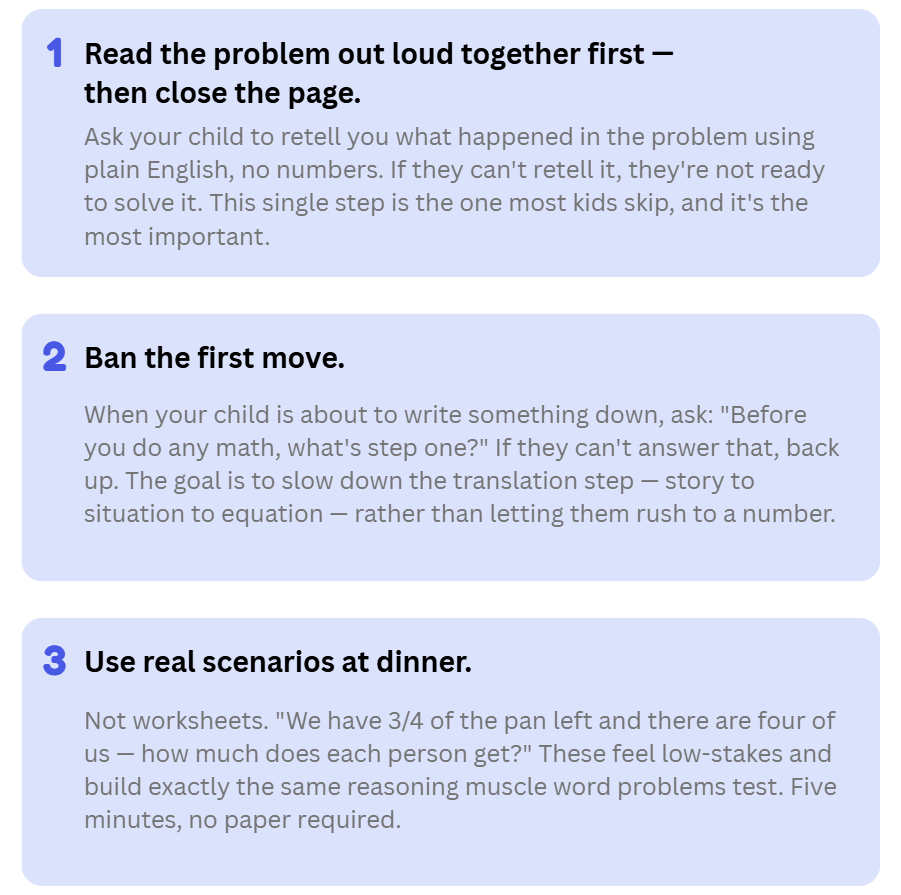
Here's what I share with parents when they ask how to help at home. None of this requires a teaching background, it only requires a few minutes and a willingness to slow down alongside your child.
When Home Practice Isn't Enough
When I see a student who consistently shuts down at word problems — not occasionally, but every time — it usually means one of two things. Either their reading comprehension is working against them in math contexts, or they've built up a strong avoidance response after too much repeated frustration. Both are real. Neither one gets fixed with more worksheets.
After 3–4 weeks of trying the strategies above with no real progress, that's usually my signal to bring in a fresh perspective. In my experience, a one-on-one session can identify the exact sticking point in about 45 minutes — something that can take months to surface in a classroom of 25 kids. I've seen it play out that way more times than I can count.
After 3–4 weeks of trying the strategies above with no real progress, that's usually my signal to bring in a fresh perspective. In my experience, a one-on-one session can identify the exact sticking point in about 45 minutes — something that can take months to surface in a classroom of 25 kids. I've seen it play out that way more times than I can count.
Why I Teach at Cosmo
It's part of why I teach at Cosmo. Every session I teach is live and one-on-one, which means I can watch what a student does in the first 30 seconds of reading a problem — where they hesitate, whether it's the language, the multi-step logic, or just the anxiety of not knowing where to start — and adjust right there in the moment. That kind of real-time read is very hard to get in a classroom of 25 kids.
Mila is heading into 6th grade now. Word problems will only get harder. There will be more steps, more real-world context, and more places to lose the thread. But she's going in with something she didn't have at the start of 5th grade: the quiet confidence that she can reason her way through a problem she doesn't immediately understand.
After eleven years of teaching math, that shift — from frozen to finishing on her own — is still the one I'm most proud to be part of
Mila is heading into 6th grade now. Word problems will only get harder. There will be more steps, more real-world context, and more places to lose the thread. But she's going in with something she didn't have at the start of 5th grade: the quiet confidence that she can reason her way through a problem she doesn't immediately understand.
After eleven years of teaching math, that shift — from frozen to finishing on her own — is still the one I'm most proud to be part of