
What's the Best Way to Tutor Your Child? A Comparison of Every Approach
May 20, 2026
You've decided your child needs more support. That part was actually the easy decision.
Now you're staring at a browser full of tabs — a worksheet center in the strip mall near your grocery store, a recommendation from a school parent for some tutor named "Miss Sarah," three different apps your kid's teacher mentioned at conferences, and a handful of online platforms with slick websites and unclear pricing. Every option sounds reasonable. None of them tells you which one is right for your child.
That confusion is more common than you'd think. Despite the tutoring industry growing into a nearly $100 billion global market, fewer than 2% of American students receive what researchers classify as high-quality tutoring — sessions frequent enough, individualized enough, and long enough to make a real difference. Most families spend money on something that helps a little. A much smaller group finds something that actually moves the needle.
This article breaks down every major tutoring approach — what each one actually is, who it works best for, and where it tends to fall short. By the end, you'll have a clear framework for deciding, not just a list of options.
Now you're staring at a browser full of tabs — a worksheet center in the strip mall near your grocery store, a recommendation from a school parent for some tutor named "Miss Sarah," three different apps your kid's teacher mentioned at conferences, and a handful of online platforms with slick websites and unclear pricing. Every option sounds reasonable. None of them tells you which one is right for your child.
That confusion is more common than you'd think. Despite the tutoring industry growing into a nearly $100 billion global market, fewer than 2% of American students receive what researchers classify as high-quality tutoring — sessions frequent enough, individualized enough, and long enough to make a real difference. Most families spend money on something that helps a little. A much smaller group finds something that actually moves the needle.
This article breaks down every major tutoring approach — what each one actually is, who it works best for, and where it tends to fall short. By the end, you'll have a clear framework for deciding, not just a list of options.
The 5 Main Tutoring Approaches (And What They Actually Deliver)
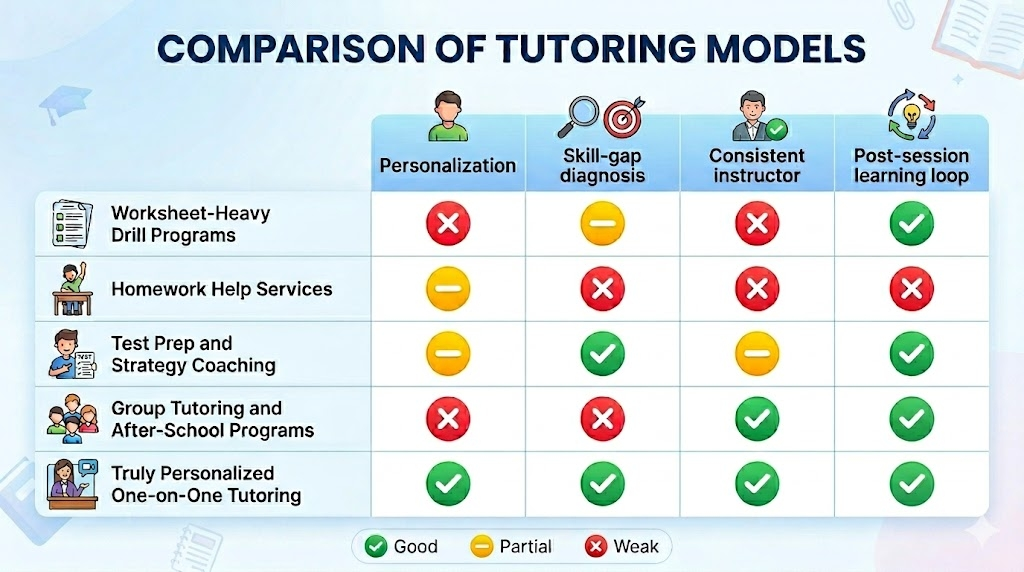
1. Private One-on-One Tutoring (In-Person)
This is the gold standard — and the research backs that up. A 2025 report from the Alliance for Learning Innovation found that high-dosage one-on-one tutoring produces three to four additional months of learning compared to no tutoring, outperforming every other academic intervention studied.
What makes it work is simple: the session is entirely about your child. If your 5th grader suddenly freezes when fractions appear in word problems but speeds through computation, a skilled tutor catches that in the first two sessions and builds their entire approach around it. No class of 25 students, no pacing guide to follow — just your kid's actual gaps.
Best for: Students with a specific, identifiable skill gap; students who shut down in group settings; students preparing for a high-stakes transition (entering middle school, approaching the SAT).
Watch out for: Quality varies wildly. A college student charging $20/hour and an experienced credentialed tutor charging $80/hour are not the same thing and will not get the same results. Ask about their approach to diagnosis — a good tutor should be able to tell you within two sessions exactly where your child is struggling and why.
What makes it work is simple: the session is entirely about your child. If your 5th grader suddenly freezes when fractions appear in word problems but speeds through computation, a skilled tutor catches that in the first two sessions and builds their entire approach around it. No class of 25 students, no pacing guide to follow — just your kid's actual gaps.
Best for: Students with a specific, identifiable skill gap; students who shut down in group settings; students preparing for a high-stakes transition (entering middle school, approaching the SAT).
Watch out for: Quality varies wildly. A college student charging $20/hour and an experienced credentialed tutor charging $80/hour are not the same thing and will not get the same results. Ask about their approach to diagnosis — a good tutor should be able to tell you within two sessions exactly where your child is struggling and why.
2. Online One-on-One Tutoring
For years, parents worried that online tutoring was a watered-down version of the real thing. Recent research has largely put that concern to rest. Well-designed virtual one-on-one sessions now produce effect sizes nearly identical to in-person tutoring — the key word being "well-designed," meaning live interaction with a real teacher, not a pre-recorded video your child half-watches.
The practical advantages are significant. You're not limited to whoever happens to live within 20 minutes of your house. Your child can work with a teacher who specializes in exactly their grade and subject, and sessions can happen without anyone leaving the house, which matters a lot when you're already managing a full school-week schedule.
Best for: Families in areas with limited local tutor options; students who actually focus better on a screen than in person (yes, this is some kids); busy schedules where commute time to a tutor isn't feasible.
Watch out for: The word "online tutoring" covers a huge range — from highly qualified specialists to crowdsourced platforms where anyone can sign up to tutor. The live, interactive piece is non-negotiable. If a session is pre-recorded or if the student-to-teacher ratio is more than 2:1, it's a different category of service, and the research on effectiveness doesn't apply.
The practical advantages are significant. You're not limited to whoever happens to live within 20 minutes of your house. Your child can work with a teacher who specializes in exactly their grade and subject, and sessions can happen without anyone leaving the house, which matters a lot when you're already managing a full school-week schedule.
Best for: Families in areas with limited local tutor options; students who actually focus better on a screen than in person (yes, this is some kids); busy schedules where commute time to a tutor isn't feasible.
Watch out for: The word "online tutoring" covers a huge range — from highly qualified specialists to crowdsourced platforms where anyone can sign up to tutor. The live, interactive piece is non-negotiable. If a session is pre-recorded or if the student-to-teacher ratio is more than 2:1, it's a different category of service, and the research on effectiveness doesn't apply.
3. Learning Centers (Kumon, Mathnasium, Sylvan, and Similar)
Walk into most learning centers and you'll find students working through structured worksheets or modules, often in a shared room with a few other kids. An instructor circulates to check work and offer guidance. It's more interactive than homework alone — but it's not one-on-one instruction in the way most parents picture when they hear the word "tutoring."
Kumon, the largest of these programs with over 6 million students worldwide, is built on self-paced repetition — the idea being that mastery of fundamentals through consistent, incremental practice builds confidence over time. For some kids, especially those who thrive on routine and respond well to visible progress, this works. For kids who are confused about why they're making errors — not just that they're making them — worksheet repetition tends to reinforce the confusion rather than resolve it.
Best for: Students who are slightly behind and need consistent, structured practice to build automaticity (quick recall of math facts, phonics patterns, and similar foundational skills); families who want a predictable weekly commitment with clear milestones.
Watch out for: Learning centers vary significantly by location — the same brand can feel completely different depending on the staff. Before enrolling, ask specifically: how much one-on-one instruction does my child receive per session, vs. independent practice? If the answer is "mostly independent," recalibrate your expectations accordingly.
Kumon, the largest of these programs with over 6 million students worldwide, is built on self-paced repetition — the idea being that mastery of fundamentals through consistent, incremental practice builds confidence over time. For some kids, especially those who thrive on routine and respond well to visible progress, this works. For kids who are confused about why they're making errors — not just that they're making them — worksheet repetition tends to reinforce the confusion rather than resolve it.
Best for: Students who are slightly behind and need consistent, structured practice to build automaticity (quick recall of math facts, phonics patterns, and similar foundational skills); families who want a predictable weekly commitment with clear milestones.
Watch out for: Learning centers vary significantly by location — the same brand can feel completely different depending on the staff. Before enrolling, ask specifically: how much one-on-one instruction does my child receive per session, vs. independent practice? If the answer is "mostly independent," recalibrate your expectations accordingly.
4. Tutoring Apps and Self-Paced Platforms (Khan Academy, IXL, and Similar)
These platforms have genuine value — and genuine limits. Khan Academy's free, well-organized video library has helped millions of students review concepts they missed in class, and IXL's adaptive question engine is genuinely good at identifying gaps. Used consistently, they can maintain skills over summer, prepare a student for a topic before it's introduced in class, or give a parent a clear map of what their child does and doesn't know.
What they can't do is notice that your child says "I get it" and then guesses randomly for the next five questions. They can't ask "wait — what did you think this step was doing?" They can't read the frustration in your kid's face three minutes before a meltdown and redirect the session. That interactive, responsive layer is what separates a platform from a teacher.
Research supports this distinction: students who are motivated and already reasonably close to grade level benefit most from self-paced platforms. Students who are significantly behind — and therefore less likely to engage independently — show much smaller gains.
Best for: Enrichment and review for students at or above grade level; summer skill maintenance; supplementing (not replacing) live instruction for a student actively working with a tutor.
Watch out for: It's very easy to mistake "my child is using the app" for "my child is learning." Time on screen is not the same as progress. Check in on actual skill metrics — most platforms show mastery percentages — not just whether they logged in.
What they can't do is notice that your child says "I get it" and then guesses randomly for the next five questions. They can't ask "wait — what did you think this step was doing?" They can't read the frustration in your kid's face three minutes before a meltdown and redirect the session. That interactive, responsive layer is what separates a platform from a teacher.
Research supports this distinction: students who are motivated and already reasonably close to grade level benefit most from self-paced platforms. Students who are significantly behind — and therefore less likely to engage independently — show much smaller gains.
Best for: Enrichment and review for students at or above grade level; summer skill maintenance; supplementing (not replacing) live instruction for a student actively working with a tutor.
Watch out for: It's very easy to mistake "my child is using the app" for "my child is learning." Time on screen is not the same as progress. Check in on actual skill metrics — most platforms show mastery percentages — not just whether they logged in.
5. Peer Tutoring and Study Groups
A classmate, an older sibling, a neighbor in the same grade — peer tutoring is genuinely underrated for some students, and genuinely useless for others. The research on peer tutoring in structured academic settings (where older students are trained to teach younger ones) is actually quite positive. But "my kid and their friend do homework together on Tuesdays" is usually more social hour than academic support.
Best for: Students who shut down with adult instruction but open up with peers; reinforcing material the student already partially knows (a peer can help with practice, not explanation); building confidence for students who feel behind in class.
Watch out for: Peer tutoring can entrench misconceptions just as easily as correct understanding — a peer who learned a procedure incorrectly will pass that along. If your child is genuinely struggling, a peer tutor is not the right first call.
Best for: Students who shut down with adult instruction but open up with peers; reinforcing material the student already partially knows (a peer can help with practice, not explanation); building confidence for students who feel behind in class.
Watch out for: Peer tutoring can entrench misconceptions just as easily as correct understanding — a peer who learned a procedure incorrectly will pass that along. If your child is genuinely struggling, a peer tutor is not the right first call.
How to Actually Choose
The honest answer is that the research strongly favors frequent, one-on-one live instruction — in person or online — over every other option. A 2022 USC Schaeffer Center study found that less than 2% of American students receive tutoring that meets the minimum threshold for meaningful academic impact: at least three sessions per week, 30+ minutes each, with a ratio of no more than four students per instructor. Most families aren't anywhere near that — and most options on the market aren't designed to get there.
That doesn't mean everything else is worthless. It means frequency and individual attention are the variables that matter most, regardless of format. Two solid one-on-one sessions per week — in person or online — will outperform five sessions in a group almost every time.
A practical framework for deciding:
• If your child is more than one grade level behind in a core subject → prioritize live one-on-one instruction, in person or online, at minimum twice weekly.
• If your child is at grade level but slipping → a learning center combined with a good app may be enough to stabilize.
• If your child is ahead and you want enrichment → self-paced platforms and occasional live check-ins work well.
• If you're unsure where your child actually stands → start with a diagnostic session from a live tutor before committing to any program. Most of the time, parents are surprised by the results — both what their child doesn't know yet, and what they know better than expected.
That doesn't mean everything else is worthless. It means frequency and individual attention are the variables that matter most, regardless of format. Two solid one-on-one sessions per week — in person or online — will outperform five sessions in a group almost every time.
A practical framework for deciding:
• If your child is more than one grade level behind in a core subject → prioritize live one-on-one instruction, in person or online, at minimum twice weekly.
• If your child is at grade level but slipping → a learning center combined with a good app may be enough to stabilize.
• If your child is ahead and you want enrichment → self-paced platforms and occasional live check-ins work well.
• If you're unsure where your child actually stands → start with a diagnostic session from a live tutor before committing to any program. Most of the time, parents are surprised by the results — both what their child doesn't know yet, and what they know better than expected.
When Nothing Seems to Be Working
If you've tried one or more of the above and you're still not seeing progress after four to six weeks, the issue is rarely the format. It's usually one of three things: the sessions aren't frequent enough (once a week is rarely sufficient for a student significantly behind), the tutor isn't adapting to how your specific child processes information, or there's an underlying learning difference that hasn't been identified.
That third possibility is worth taking seriously. ADHD, dyslexia, dyscalculia, and processing differences are consistently underidentified in schools — and they don't show up on report cards until the gap becomes too large to ignore. If your child is working hard and still not making progress, a conversation with your pediatrician or school psychologist is worth having before changing tutors again.
That third possibility is worth taking seriously. ADHD, dyslexia, dyscalculia, and processing differences are consistently underidentified in schools — and they don't show up on report cards until the gap becomes too large to ignore. If your child is working hard and still not making progress, a conversation with your pediatrician or school psychologist is worth having before changing tutors again.
How Cosmo Fits Into This
Cosmo's live tutoring is built specifically around the variables the research identifies as most important — one-on-one attention, subject-specific expertise, and enough session frequency to create real momentum. Every class is with a real teacher, adapted to your child's actual level, not a curriculum pacing guide.
If you're not sure where to start — or whether your child needs tutoring at all — a single diagnostic session with a Cosmo teacher will tell you more about where your child actually stands than a semester of report card grades. It's a real picture, from someone who's working directly with your kid, with no obligation to continue.
If you're not sure where to start — or whether your child needs tutoring at all — a single diagnostic session with a Cosmo teacher will tell you more about where your child actually stands than a semester of report card grades. It's a real picture, from someone who's working directly with your kid, with no obligation to continue.