
He Hated Writing. Eight Classes Later, He Spent 2.5 Hours on One Essay.
May 05, 2026
The first thing Elijah's mom noticed during his trial class was what he didn't say.
The teacher asked him about school — what he liked, what he was good at. He lit up immediately. Math. Biology. Science. Physics. He listed them fast, the way kids do when they're proud of something. The teacher listened, then said with a small laugh: "I didn't hear reading. But that's OK. We'll change that."
His mom, sitting nearby, recognized that moment. She'd been hearing versions of it for a while — her son was sharp, curious, athletic, genuinely enthusiastic about learning. But put a writing assignment in front of him and everything stalled. Sentences ran into each other. Ideas were there, but they tangled. He knew what he wanted to say. Getting it onto the page was another thing entirely.
If you're homeschooling a middle schooler and you've watched this happen — the bright kid who freezes at a blank document — this story is for you.
The teacher asked him about school — what he liked, what he was good at. He lit up immediately. Math. Biology. Science. Physics. He listed them fast, the way kids do when they're proud of something. The teacher listened, then said with a small laugh: "I didn't hear reading. But that's OK. We'll change that."
His mom, sitting nearby, recognized that moment. She'd been hearing versions of it for a while — her son was sharp, curious, athletic, genuinely enthusiastic about learning. But put a writing assignment in front of him and everything stalled. Sentences ran into each other. Ideas were there, but they tangled. He knew what he wanted to say. Getting it onto the page was another thing entirely.
If you're homeschooling a middle schooler and you've watched this happen — the bright kid who freezes at a blank document — this story is for you.
Why Writing Feels Different From Every Other Subject
Math has right answers. Science has experiments. Even reading feels manageable once the words make sense.
Writing is different. It asks kids to simultaneously hold an idea in their head, organize it logically, translate it into sentences, and follow a set of rules they're still internalizing — all at the same time. For kids who are strong visual or auditory learners (Elijah was both), that cognitive load is genuinely harder than it looks from the outside.
According to the 2024 National Assessment of Educational Progress (NAEP), only 33% of 8th graders nationwide perform at or above the proficient level in reading. That's not a reflection of intelligence — it's a reflection of how rarely writing gets broken down into learnable, sequential steps the way math does.
For homeschool families especially, writing instruction is one of the hardest things to teach at home. Not because parents aren't capable, but because good writing feedback requires a trained eye, a different voice than Mom or Dad's, and — crucially — a relationship where the child is willing to be corrected.
Writing is different. It asks kids to simultaneously hold an idea in their head, organize it logically, translate it into sentences, and follow a set of rules they're still internalizing — all at the same time. For kids who are strong visual or auditory learners (Elijah was both), that cognitive load is genuinely harder than it looks from the outside.
According to the 2024 National Assessment of Educational Progress (NAEP), only 33% of 8th graders nationwide perform at or above the proficient level in reading. That's not a reflection of intelligence — it's a reflection of how rarely writing gets broken down into learnable, sequential steps the way math does.
For homeschool families especially, writing instruction is one of the hardest things to teach at home. Not because parents aren't capable, but because good writing feedback requires a trained eye, a different voice than Mom or Dad's, and — crucially — a relationship where the child is willing to be corrected.
What "Structure Problems" Actually Look Like at Home
When Elijah's mom described his learning goals before his first class, she used a phrase that comes up constantly with middle school writers: structure problem.
It sounds vague. But in practice, it looks very specific:
• He writes the way he talks — thoughts flowing into each other without stopping, no clear beginning or end to a sentence.
• He has real ideas and real experiences to draw from, but the writing doesn't capture them the way he'd tell it out loud.
• He knows something is off when he rereads it, but he doesn't know how to fix it.
• He avoids writing assignments — not from laziness, but because the gap between what's in his head and what ends up on the page is frustrating.
The underlying issue isn't creativity or intelligence. It's that no one has yet taught him the mechanics of written language as separate skills — that a sentence is a complete thought, that a hook pulls the reader in, that dialogue has its own punctuation rules, that word choice isn't decoration but precision.
These are teachable. They just need to be taught one at a time, in the right order, with enough practice in between to stick.
It sounds vague. But in practice, it looks very specific:
• He writes the way he talks — thoughts flowing into each other without stopping, no clear beginning or end to a sentence.
• He has real ideas and real experiences to draw from, but the writing doesn't capture them the way he'd tell it out loud.
• He knows something is off when he rereads it, but he doesn't know how to fix it.
• He avoids writing assignments — not from laziness, but because the gap between what's in his head and what ends up on the page is frustrating.
The underlying issue isn't creativity or intelligence. It's that no one has yet taught him the mechanics of written language as separate skills — that a sentence is a complete thought, that a hook pulls the reader in, that dialogue has its own punctuation rules, that word choice isn't decoration but precision.
These are teachable. They just need to be taught one at a time, in the right order, with enough practice in between to stick.
The Turning Point That Didn't Look Like One
By the fourth class, Elijah's teacher — Miss Rhonda — reviewed a homework piece he'd written: a short narrative about a real memory, a trip to a water park that got shut down by a lightning storm.
The story had everything in it. A hook. A conflict. A resolution. He'd even written it in the first person, with a voice that was clearly his. But it was full of run-on sentences — thoughts crashing into each other with no punctuation to separate them.
Miss Rhonda didn't mark it wrong and move on. She read it with him. She pointed to a specific line — "we waited there for the next hour luckily there was an ice cream shop nearby" — and asked: where does one thought end and the next one begin? He got it immediately. A period. Or a comma and a conjunction. That's all it needed.
The homework for the next class: rewrite one paragraph, focusing only on run-on sentences. No other edits required.
That's the kind of assignment that doesn't feel big. One paragraph. One skill. But it's exactly the kind of focused, sequential instruction that builds writers — not all at once, but piece by piece.
The story had everything in it. A hook. A conflict. A resolution. He'd even written it in the first person, with a voice that was clearly his. But it was full of run-on sentences — thoughts crashing into each other with no punctuation to separate them.
Miss Rhonda didn't mark it wrong and move on. She read it with him. She pointed to a specific line — "we waited there for the next hour luckily there was an ice cream shop nearby" — and asked: where does one thought end and the next one begin? He got it immediately. A period. Or a comma and a conjunction. That's all it needed.
The homework for the next class: rewrite one paragraph, focusing only on run-on sentences. No other edits required.
That's the kind of assignment that doesn't feel big. One paragraph. One skill. But it's exactly the kind of focused, sequential instruction that builds writers — not all at once, but piece by piece.
Class Eight: "I Went Through It Four Times"
Four classes later, Miss Rhonda opened their session expecting to review a short paragraph.
Instead, Elijah had sent her an essay.
When she told him she'd asked for maybe five sentences, he said: "It took me like 2.5 hours. I did it right after class. I went through it like four times. I still think I could have gone through it a little better."
She told him she was proud. Then she told him something that reframed the whole thing: "That's not rewriting. That's polishing. Like when you're learning a trick on a skateboard — you don't do it once and go, got it. You do it over and over until you perfect it. That's exactly what writing is."
He'd started the essay with a line of dialogue — "Run, run!" — the way he'd been taught to open a narrative with something that pulls the reader in immediately. He'd used the word teeming to describe a crowded hallway, because he and Miss Rhonda had looked it up together two classes earlier and he'd liked the sound of it. He was applying what he'd learned. Not because he was told to. Because it was starting to feel like his.
Instead, Elijah had sent her an essay.
When she told him she'd asked for maybe five sentences, he said: "It took me like 2.5 hours. I did it right after class. I went through it like four times. I still think I could have gone through it a little better."
She told him she was proud. Then she told him something that reframed the whole thing: "That's not rewriting. That's polishing. Like when you're learning a trick on a skateboard — you don't do it once and go, got it. You do it over and over until you perfect it. That's exactly what writing is."
He'd started the essay with a line of dialogue — "Run, run!" — the way he'd been taught to open a narrative with something that pulls the reader in immediately. He'd used the word teeming to describe a crowded hallway, because he and Miss Rhonda had looked it up together two classes earlier and he'd liked the sound of it. He was applying what he'd learned. Not because he was told to. Because it was starting to feel like his.
What This Tells Us About How Writing Actually Improves
Elijah's shift from "I didn't hear writing on that list" to spending 2.5 hours voluntarily on an essay didn't happen because of a single breakthrough moment. It happened because of sequence.
Each class targeted one skill: hooks first, then sequencing, then character development, then dialogue punctuation, then word choice. By the time he was writing full essays, he had a toolkit. He wasn't staring at a blank page trying to do everything at once. He was doing things he'd already practiced.
This is why writing instruction works best when it's structured and cumulative — and why it's so hard to replicate at home. It's not that parents don't care or don't try. It's that breaking writing down into discrete, sequenced micro-skills while also giving feedback on this week's draft is genuinely difficult to do when you're also the parent.
A trained teacher who is not Mom or Dad also changes the dynamic in ways that matter more than parents usually expect. Kids accept correction differently from someone outside the family. They ask questions they wouldn't ask at home. They take risks on the page they'd normally avoid.
Each class targeted one skill: hooks first, then sequencing, then character development, then dialogue punctuation, then word choice. By the time he was writing full essays, he had a toolkit. He wasn't staring at a blank page trying to do everything at once. He was doing things he'd already practiced.
This is why writing instruction works best when it's structured and cumulative — and why it's so hard to replicate at home. It's not that parents don't care or don't try. It's that breaking writing down into discrete, sequenced micro-skills while also giving feedback on this week's draft is genuinely difficult to do when you're also the parent.
A trained teacher who is not Mom or Dad also changes the dynamic in ways that matter more than parents usually expect. Kids accept correction differently from someone outside the family. They ask questions they wouldn't ask at home. They take risks on the page they'd normally avoid.
If Your Middle Schooler Avoids Writing, Here's Where to Start
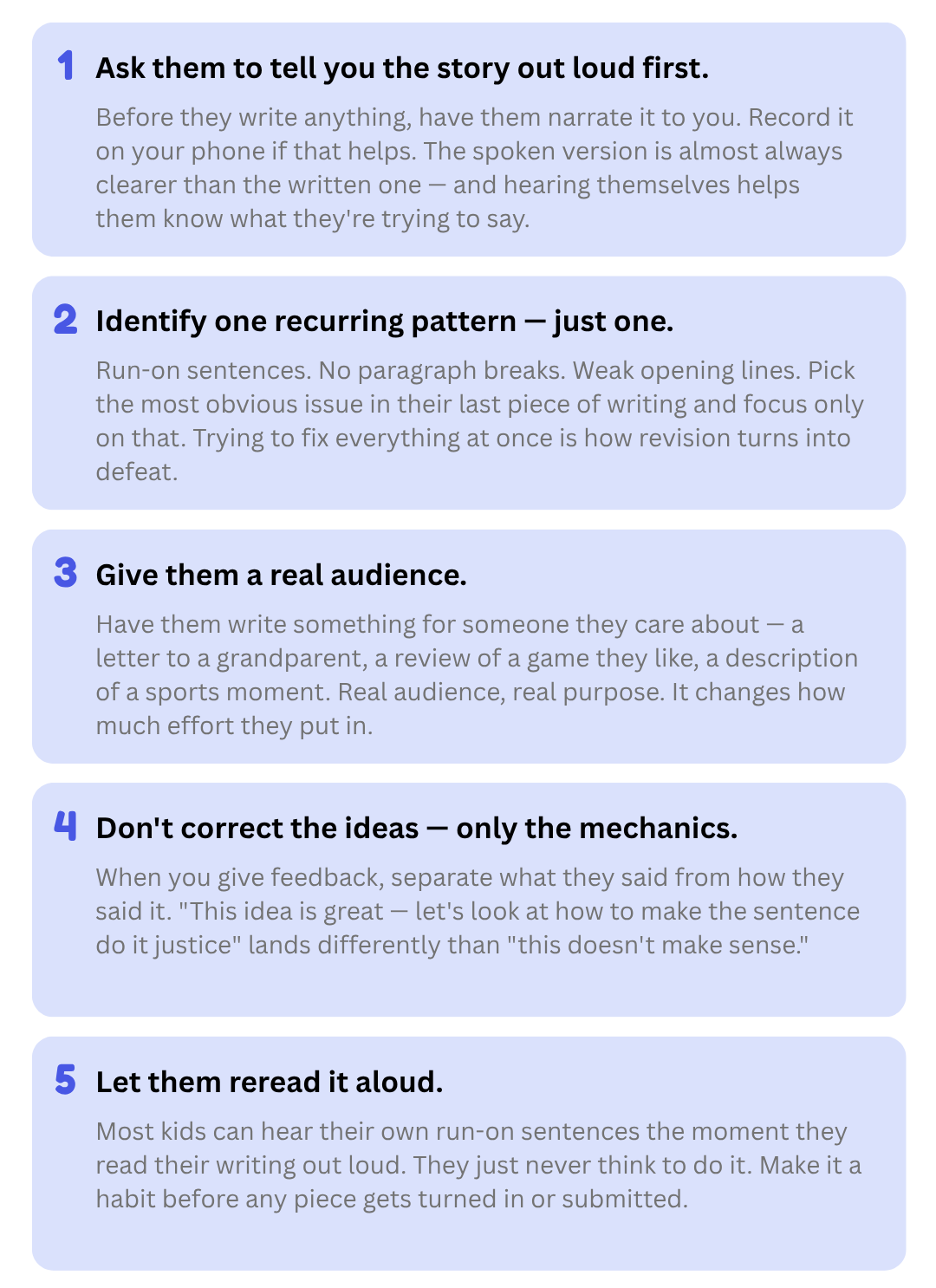
You don't need to wait for a tutor to begin. This week:
Try This With Them This Summer
Summer is the rare stretch when there's actual room for this kind of work — no graded assignments, no due dates, no teacher notes coming home on a Friday. Just the two of you, and a few open weeks where one small change can compound.
Pick one of the five steps above. Just one. Try it for two weeks and see what shifts. Maybe you discover that reading aloud is the only edit your child actually needs. Maybe you find that the audience matters more than the prompt. Maybe you realize that praising the idea before touching the sentence changes how willing they are to revise. Whatever you learn, you'll head into the fall knowing something specific about how your child writes — and that's worth a lot more than another worksheet.
You don't need to be an English teacher to help your kid become a better writer. You just need to be paying attention to one thing at a time, with no grade on the line. Summer is a good place to start.
Pick one of the five steps above. Just one. Try it for two weeks and see what shifts. Maybe you discover that reading aloud is the only edit your child actually needs. Maybe you find that the audience matters more than the prompt. Maybe you realize that praising the idea before touching the sentence changes how willing they are to revise. Whatever you learn, you'll head into the fall knowing something specific about how your child writes — and that's worth a lot more than another worksheet.
You don't need to be an English teacher to help your kid become a better writer. You just need to be paying attention to one thing at a time, with no grade on the line. Summer is a good place to start.