
What I Do in the First 10 Minutes of Every Math Class — And Why It Changes Everything
May 19, 2026
I have been a Cosmo math teacher for the past two years, working primarily with middle schoolers on pre-algebra and algebra. The class I describe below is a real one — the names have been changed, but every teaching moment is exactly as it happened.
Maya logged in for her Tuesday session looking a little guilty. I could tell before she said a word.
She mentioned she had been about to eat dinner. We said our hellos. Then I looked at her homework — seven algebraic expression problems I had assigned at the end of our last class. She had answered four of them. The last three, the harder ones, were blank.
Some tutors would move on. Seven problems, mostly done — close enough. We have new material to cover, and the clock is running. Let's go.
I don't do that. Not because I'm strict about homework completion, but because those three blank problems are telling me something I need to know before I can teach Maya anything new.
Maya logged in for her Tuesday session looking a little guilty. I could tell before she said a word.
She mentioned she had been about to eat dinner. We said our hellos. Then I looked at her homework — seven algebraic expression problems I had assigned at the end of our last class. She had answered four of them. The last three, the harder ones, were blank.
Some tutors would move on. Seven problems, mostly done — close enough. We have new material to cover, and the clock is running. Let's go.
I don't do that. Not because I'm strict about homework completion, but because those three blank problems are telling me something I need to know before I can teach Maya anything new.
The First 10 Minutes Aren't a Warmup: They're a Diagnosis
Every class I teach starts the same way: we go over what happened last session before we touch anything new. Not to check whether homework got done. To find out what stuck and what didn't.
This is backed by decades of research on how memory works. When students retrieve information they learned previously — even imperfectly, even just by attempting a problem — they retain it significantly better than if they had simply re-read their notes. Researchers call this spaced retrieval practice, and it is one of the most consistently effective learning strategies in cognitive science.
In a school classroom, there is rarely time for this. A teacher with 28 students moves on by necessity. In a one-on-one session, I don't have that excuse — and I use that advantage every single class.
With Maya, going over those seven problems took about eight minutes. In those eight minutes, I learned more about where she actually was than any test score could have told me.
This is backed by decades of research on how memory works. When students retrieve information they learned previously — even imperfectly, even just by attempting a problem — they retain it significantly better than if they had simply re-read their notes. Researchers call this spaced retrieval practice, and it is one of the most consistently effective learning strategies in cognitive science.
In a school classroom, there is rarely time for this. A teacher with 28 students moves on by necessity. In a one-on-one session, I don't have that excuse — and I use that advantage every single class.
With Maya, going over those seven problems took about eight minutes. In those eight minutes, I learned more about where she actually was than any test score could have told me.
What the Homework Tells Me That a Report Card Never Could
Problems one through four: she could write basic expressions. "Four more than five times a number" — she had it. She understood that "more than" means addition, that "five times" means multiplication. She knew the order mattered.
Problems five through seven — the ones she left blank — were a different story.
Problem five asked her to write an expression using the word "quotient." She didn't know what quotient meant. Not a wrong guess. She had genuinely never connected that word to division. Problem six used the word "cubed," and she stopped cold. She asked me what it meant.
That's not a math gap. That's a vocabulary gap. And it is one of the most common things I see with 6th graders approaching algebra — especially students who haven't formally started this topic in school yet. Maya told me as much: she was working ahead of her classroom curriculum. Without the vocabulary scaffolding her school hadn't yet given her, three of the seven problems were impossible before she had even begun.
Knowing this changes everything about how I teach the rest of the class.
Problems five through seven — the ones she left blank — were a different story.
Problem five asked her to write an expression using the word "quotient." She didn't know what quotient meant. Not a wrong guess. She had genuinely never connected that word to division. Problem six used the word "cubed," and she stopped cold. She asked me what it meant.
That's not a math gap. That's a vocabulary gap. And it is one of the most common things I see with 6th graders approaching algebra — especially students who haven't formally started this topic in school yet. Maya told me as much: she was working ahead of her classroom curriculum. Without the vocabulary scaffolding her school hadn't yet given her, three of the seven problems were impossible before she had even begun.
Knowing this changes everything about how I teach the rest of the class.
The Keyword System: What I Build Before Every New Lesson
Before I introduced a single new problem, I stopped and built the map.
Every operation in algebra has a set of words that signal it. Once you know the vocabulary, the word problems unlock:
Every operation in algebra has a set of words that signal it. Once you know the vocabulary, the word problems unlock:
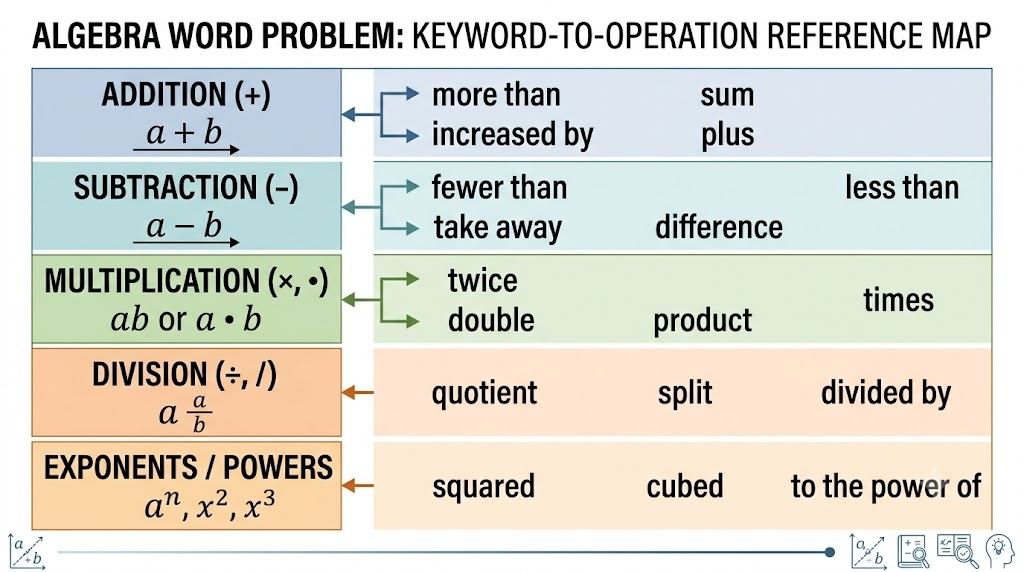
I didn't hand Maya a list to memorize. I built it with her, problem by problem, as a reference to use in real time — the way you would use a dictionary. When you see "quotient," look it up in your mental map: that's division. In algebra, division becomes a fraction. So K cubed divided by two to the fifth power becomes K to the third over 2 to the fifth.
Once she had that map, something shifted. Problems that had felt impossible five minutes earlier started to crack open. She was reasoning about what the words were telling her to do — not just guessing.
I could have skipped this step. She had gotten four of seven right, and part of me wanted to assume she had enough of the foundation. Checking taught me she didn't. That is exactly the kind of assumption that costs students weeks of confused practice on shaky ground.
Once she had that map, something shifted. Problems that had felt impossible five minutes earlier started to crack open. She was reasoning about what the words were telling her to do — not just guessing.
I could have skipped this step. She had gotten four of seven right, and part of me wanted to assume she had enough of the foundation. Checking taught me she didn't. That is exactly the kind of assumption that costs students weeks of confused practice on shaky ground.
The Bridge: How Review Flows Into New Learning
Here is something parents don't always see from the outside: when the first ten minutes work, there is no visible moment where we "switch" from reviewing to learning something new. The transition is invisible because it is the same work.
After we fixed Maya's vocabulary gaps, I moved her into a set of real-world word problems. How do you write an expression for the cost of ordering N lunches at $8.25 each, plus a one-time delivery fee? Which expression represents the length of one interstate highway relative to another? These weren't easier than the homework problems she had left blank. They were harder. But she worked through most of them — because we had built the foundation underneath her in those first ten minutes.
That is the goal every single session: not to cover the most material, but to make sure what we cover actually lands.
After we fixed Maya's vocabulary gaps, I moved her into a set of real-world word problems. How do you write an expression for the cost of ordering N lunches at $8.25 each, plus a one-time delivery fee? Which expression represents the length of one interstate highway relative to another? These weren't easier than the homework problems she had left blank. They were harder. But she worked through most of them — because we had built the foundation underneath her in those first ten minutes.
That is the goal every single session: not to cover the most material, but to make sure what we cover actually lands.
What You Can Do at Home
You don't have to be a math person to support this kind of learning. A few things that genuinely help:
Before a session, ask one question: "What did you work on last time?" Not "did you finish your homework?" but "what did you work on?" Making your child retrieve the information from memory, even loosely, gives their brain a running start. Research shows this kind of low-effort retrieval before new learning meaningfully improves long-term retention.
If your child skips homework between sessions, don't just let it go. Incomplete homework isn't a moral issue, but it is a signal worth paying attention to. Is the work too hard? Did they hit a wall and not know how to ask for help? Understanding which one changes what you do next.
Ask your child to teach you one thing from their last session. It doesn't matter if you understand the answer. The act of explaining it, putting it into their own words, is one of the most powerful ways to make knowledge stick.
Before a session, ask one question: "What did you work on last time?" Not "did you finish your homework?" but "what did you work on?" Making your child retrieve the information from memory, even loosely, gives their brain a running start. Research shows this kind of low-effort retrieval before new learning meaningfully improves long-term retention.
If your child skips homework between sessions, don't just let it go. Incomplete homework isn't a moral issue, but it is a signal worth paying attention to. Is the work too hard? Did they hit a wall and not know how to ask for help? Understanding which one changes what you do next.
Ask your child to teach you one thing from their last session. It doesn't matter if you understand the answer. The act of explaining it, putting it into their own words, is one of the most powerful ways to make knowledge stick.
What to Look for in a Tutor (From Someone Who Is One)
The reason I can spend ten minutes on homework review without falling behind is simple: I am teaching one student at a time. That is the whole model.
I have worked in classrooms where I had 28 students and 45 minutes. In that setting, even if I wanted to spend eight minutes figuring out why one student left three problems blank, I couldn't. You move on or you lose everyone.
One-on-one, I don't have that problem. If Maya doesn't know what "quotient" means, we stop and fix it before we go anywhere. That's not a luxury in my sessions. That's the job.
Whatever tutoring you choose for your child — online, in-person, through a platform or a private tutor — I'd encourage you to ask one question: does this teacher review before introducing? A tutor who treats homework as data, not just a grade, and who diagnoses gaps before teaching new material, is going to build something durable. A tutor who skips past it every session is building on sand.
That's what I try to do in every class I teach at Cosmo. If it sounds like what your child needs, I'd say come try a session. The first one is free. I promise the first ten minutes will tell you a lot.
I have worked in classrooms where I had 28 students and 45 minutes. In that setting, even if I wanted to spend eight minutes figuring out why one student left three problems blank, I couldn't. You move on or you lose everyone.
One-on-one, I don't have that problem. If Maya doesn't know what "quotient" means, we stop and fix it before we go anywhere. That's not a luxury in my sessions. That's the job.
Whatever tutoring you choose for your child — online, in-person, through a platform or a private tutor — I'd encourage you to ask one question: does this teacher review before introducing? A tutor who treats homework as data, not just a grade, and who diagnoses gaps before teaching new material, is going to build something durable. A tutor who skips past it every session is building on sand.
That's what I try to do in every class I teach at Cosmo. If it sounds like what your child needs, I'd say come try a session. The first one is free. I promise the first ten minutes will tell you a lot.