
What Is Singapore Math, and Why It Works So Well
July 03, 2026
If you’ve been looking into ways to help your child with math, you’ve almost certainly run across the term Singapore Math. It shows up in tutoring programs, in workbooks at the bookstore, and in conversations among parents who seem to know something you don’t. What’s usually missing is a plain explanation of what it actually is and why so many people swear by it.
Singapore Math isn’t a brand or a gimmick. It’s the approach behind the math curriculum that has kept one small country at the top of the world’s math rankings for three decades. The reassuring part for parents is that the ideas driving it aren’t mysterious, and they translate surprisingly well to a kitchen table in the United States.
Singapore Math isn’t a brand or a gimmick. It’s the approach behind the math curriculum that has kept one small country at the top of the world’s math rankings for three decades. The reassuring part for parents is that the ideas driving it aren’t mysterious, and they translate surprisingly well to a kitchen table in the United States.
So What Is Singapore Math, Really?
Singapore Math refers to the teaching method developed for Singapore’s national school system in the 1980s and refined ever since. The results speak for themselves. On the 2023 TIMSS, the leading international math assessment, Singapore’s fourth and eighth graders ranked first in the world, with a fourth-grade score of 615. Over the same stretch, U.S. fourth-grade math scores fell 18 points from 2019 and hit their lowest level since the test began in 1995.
What makes the approach different isn’t speed or memorization. It’s the goal: mastery. Instead of racing through dozens of topics each year, Singapore Math covers fewer topics and teaches each one until children genuinely understand it, not just until they can produce the right answer. Every concept is built on the one before, so there are no shaky foundations to trip over later.
What makes the approach different isn’t speed or memorization. It’s the goal: mastery. Instead of racing through dozens of topics each year, Singapore Math covers fewer topics and teaches each one until children genuinely understand it, not just until they can produce the right answer. Every concept is built on the one before, so there are no shaky foundations to trip over later.
The CPA Approach at the Heart of Singapore Math
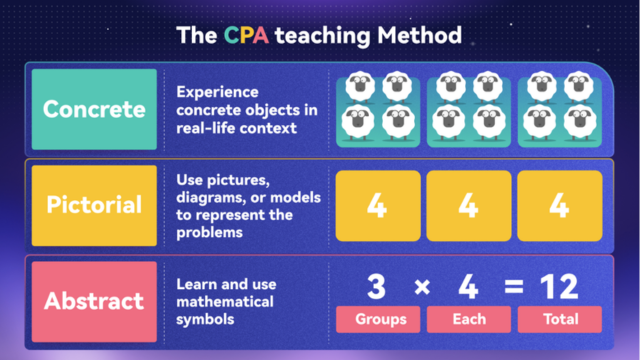
At the center of Singapore Math is a method known as CPA, short for Concrete, Pictorial, Abstract. It grew out of the work of psychologist Jerome Bruner, who argued that real understanding starts with doing, then moves to seeing, and only then to symbols. Singapore built its entire curriculum around that sequence.
Here’s how it works with something as simple as 5 + 3. In the concrete stage, a child physically groups five blocks with three more and counts them. In the pictorial stage, those blocks become drawings or dots that stand in for the objects. In the abstract stage, and only once the idea is solid, the child works with the numbers alone: 5 + 3 = 8. The symbols finally mean something, because they’re attached to an experience rather than memorized in a vacuum.
That last point is the whole game. A child who reaches the abstract stage the CPA way isn’t guessing at rules. They’re writing down something they already understand.
Here’s how it works with something as simple as 5 + 3. In the concrete stage, a child physically groups five blocks with three more and counts them. In the pictorial stage, those blocks become drawings or dots that stand in for the objects. In the abstract stage, and only once the idea is solid, the child works with the numbers alone: 5 + 3 = 8. The symbols finally mean something, because they’re attached to an experience rather than memorized in a vacuum.
That last point is the whole game. A child who reaches the abstract stage the CPA way isn’t guessing at rules. They’re writing down something they already understand.
The Bar Model, Singapore Math’s Visual Workhorse
One tool deserves special attention: the bar model. As children move from pictures toward abstract math, bar models act as the bridge between the two. A word problem that would otherwise be a wall of text turns into a few simple rectangles that show how the quantities relate.
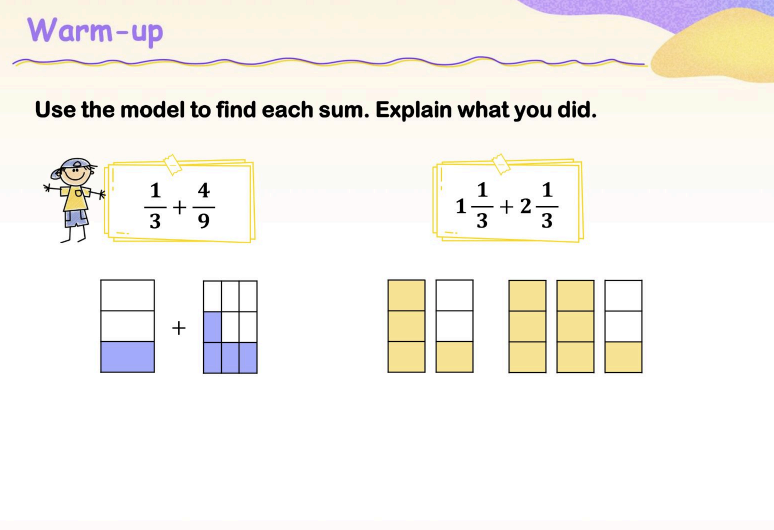
Take a classic problem: Maya has 3 times as many stickers as Leo, and together they have 24. How many does each have? Instead of guessing, a child draws one bar for Leo and three equal bars for Maya, sees four equal parts making 24, and finds each part is 6. No algebra required, yet the child is reasoning in exactly the way algebra will later ask them to. That’s why kids raised on bar models tend to find equations intuitive instead of intimidating.
Why Fewer Topics and Deeper Mastery Wins
American math has long been criticized as “a mile wide and an inch deep,” cramming so many topics into each year that none gets the time it needs. The contrast is stark. One widely cited comparison found Singapore covers roughly 15 topics in a grade where U.S. curricula averaged around 26. Fewer topics means more time to build real understanding of each one.
Because every concept is mastered before the next begins, children develop something more valuable than a pile of memorized procedures: number sense. They understand why methods work, so they can adapt when a problem looks unfamiliar. It’s the difference between a child who has memorized that you “flip and multiply” to divide fractions and one who understands what dividing by a fraction actually means.
Because every concept is mastered before the next begins, children develop something more valuable than a pile of memorized procedures: number sense. They understand why methods work, so they can adapt when a problem looks unfamiliar. It’s the difference between a child who has memorized that you “flip and multiply” to divide fractions and one who understands what dividing by a fraction actually means.
What This Means for Your Elementary Schooler
The elementary years, roughly kindergarten through fifth grade, are when this approach matters most, because that’s when children form their first mental models of how numbers behave. If your child can get answers but can’t explain how, or freezes the moment a problem doesn’t look like the example, more of the same worksheets won’t fix it. The thinking underneath needs rebuilding.
You can borrow CPA thinking at home without any special materials:
• Start concrete. When a concept is hard, reach for objects first: coins, LEGO bricks, snack pieces. Let your child solve it with their hands before picking up a pencil.
• Draw before you calculate. Ask, “Can you draw what’s happening in this problem?” A quick sketch or bar model often unlocks a word problem faster than reading it again.
• Ask why, not just what. After an answer, ask how they know it’s right. If they can explain it, the understanding is real.
• Slow down on the basics. If place value or fractions feel wobbly, it’s worth pausing there. In this approach, depth beats speed every time.
You can borrow CPA thinking at home without any special materials:
• Start concrete. When a concept is hard, reach for objects first: coins, LEGO bricks, snack pieces. Let your child solve it with their hands before picking up a pencil.
• Draw before you calculate. Ask, “Can you draw what’s happening in this problem?” A quick sketch or bar model often unlocks a word problem faster than reading it again.
• Ask why, not just what. After an answer, ask how they know it’s right. If they can explain it, the understanding is real.
• Slow down on the basics. If place value or fractions feel wobbly, it’s worth pausing there. In this approach, depth beats speed every time.
How Cosmo Teaches With the CPA Approach
This is the approach Cosmo’s math program is built on. Every Cosmo math class follows the same concrete-to-pictorial-to-abstract progression that powers Singapore Math, with bar modeling used to make word problems and early algebra visual and logical rather than mysterious. Because classes are live and personalized, the teacher can see exactly which stage a child is stuck at and meet them there, instead of pushing symbols before the understanding is ready.
Cosmo’s live math classes are built around understanding, not memorization, using the concrete, pictorial, and abstract method to make each idea click before moving on. If you’re curious whether it’s the right fit for your child, a 50-minute trial class will show you more than any description can.
Book a free class today to see it yourself!
Cosmo’s live math classes are built around understanding, not memorization, using the concrete, pictorial, and abstract method to make each idea click before moving on. If you’re curious whether it’s the right fit for your child, a 50-minute trial class will show you more than any description can.
Book a free class today to see it yourself!