
Why 6th Grade Reading Suddenly Gets Harder: A Cosmo Mid-Year Report
May 29, 2026
Every student who starts with Cosmo takes a diagnostic assessment before the trial class, a skill-by-skill snapshot of where their comprehension actually stands. Halfway through the year, we went back through our 5th and 6th grade reading assessments, tallied which specific skills got flagged as weak most often, and compared the two grades side by side. One pattern stood out clearly enough to write down.
The skills that trip up 6th graders aren't harder versions of the 5th grade ones. They're different skills entirely. Fifth grade reading is about finding and organizing information. Sixth grade reading is about analyzing and inferring it. That single shift is why so many kids who read "fine" suddenly start missing comprehension questions in 6th grade.
The skills that trip up 6th graders aren't harder versions of the 5th grade ones. They're different skills entirely. Fifth grade reading is about finding and organizing information. Sixth grade reading is about analyzing and inferring it. That single shift is why so many kids who read "fine" suddenly start missing comprehension questions in 6th grade.
The shift in our numbers
In 5th grade, the most-flagged weak skills all have to do with locating information and seeing how a text is put together:
• Determining the main idea of an informational text (about two-thirds of our 5th graders have this listed as a weak skill)
• Understanding how a text is structured chronologically (over half 5th graders have this listed as a weak skill)
• Quoting accurately from a text to support an answer (over half 5th graders have this listed as weak skills)
By 6th grade, those deficits give way to something harder. The skills that show up most often now require a reader to go beyond what's on the page:
• Analyzing how one part of a text fits into its overall structure (our single most-flagged weak skill, for nearly three-quarters of 6th graders)
• Figuring out figurative and connotative meaning, what words imply rather than just define
• Determining the meaning of words and phrases in context
• Evaluating an argument and identifying the author's purpose
Read the two lists back to back and the story is obvious. Fifth grade asks: can you find it? Sixth grade asks: can you judge what it means? A child can be genuinely strong at the first and never have been taught the second.
• Determining the main idea of an informational text (about two-thirds of our 5th graders have this listed as a weak skill)
• Understanding how a text is structured chronologically (over half 5th graders have this listed as a weak skill)
• Quoting accurately from a text to support an answer (over half 5th graders have this listed as weak skills)
By 6th grade, those deficits give way to something harder. The skills that show up most often now require a reader to go beyond what's on the page:
• Analyzing how one part of a text fits into its overall structure (our single most-flagged weak skill, for nearly three-quarters of 6th graders)
• Figuring out figurative and connotative meaning, what words imply rather than just define
• Determining the meaning of words and phrases in context
• Evaluating an argument and identifying the author's purpose
Read the two lists back to back and the story is obvious. Fifth grade asks: can you find it? Sixth grade asks: can you judge what it means? A child can be genuinely strong at the first and never have been taught the second.
Why this happens
This isn't unique to our students. Reading researchers call it the move from "learning to read" to "reading to learn" — the point where reading stops being about decoding words and starts being a tool for understanding ideas. Reading researcher Jeanne Chall first named the resulting "fourth-grade slump" in her 1983 book "Stages of Reading Development", and it's still real today. What most parents aren't told is that the shift accelerates in 6th grade, as texts get longer and questions move from "what happened" to "why it matters".
And the gap is widening nationally. On the 2024 Nation's Report Card, about a third of 8th graders scored below NAEP Basic in reading — the largest share ever recorded. Sixth grade is where that gap opens up.
And the gap is widening nationally. On the 2024 Nation's Report Card, about a third of 8th graders scored below NAEP Basic in reading — the largest share ever recorded. Sixth grade is where that gap opens up.
The trap: "they just need to read more"
When a strong reader starts missing questions, the instinct is to add reading time. But our data points to depth, not volume. A child who reads three books a week can still be unable to explain what an author implies, because inference is taught and practiced — it doesn't accumulate from page count. And these exact 6th grade skills are the foundation of 7th and 8th grade ELA and, later, the SAT reading section. A small gap now is why even a bright student can plateau in middle school.
What teaching inference actually looks like in a Cosmo class
Inference is the skill our 6th grade data flags most — so here's how we actually teach it, not just talk about it. The core move our teachers use is a simple, repeatable formula:
"What the text says" + "And I know…" = "So I can infer…"
"What the text says" + "And I know…" = "So I can infer…"
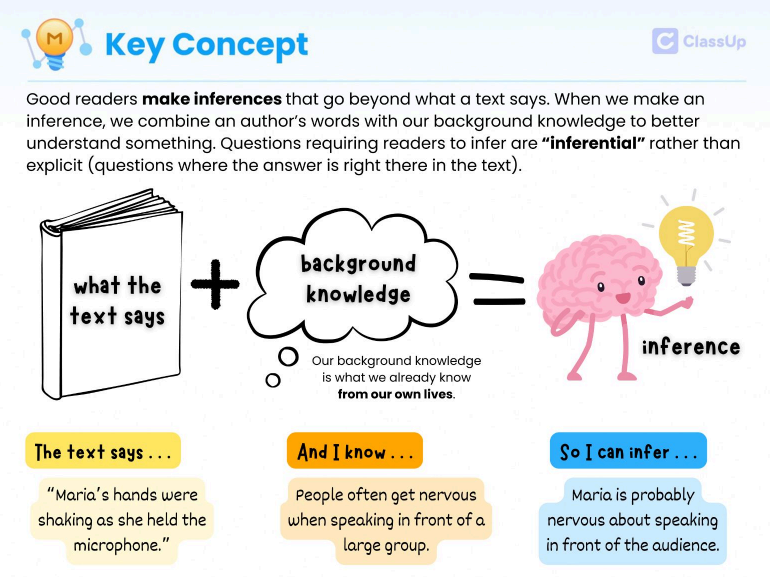
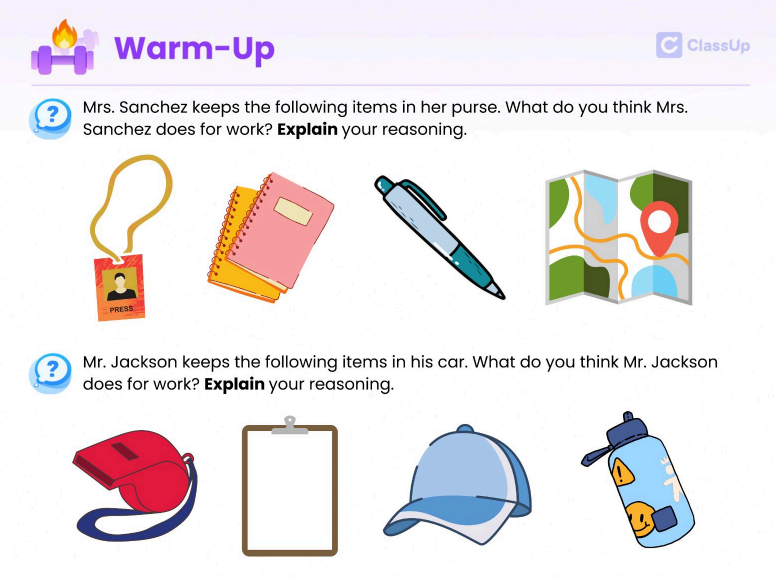
A lesson starts with a warm-up that makes the thinking visible before any reading happens. We show students the contents of someone's bag — a press badge, a notebook, a pen, a map — and ask: what does this person do for a living? Kids realize they're already inferring; they're combining clues with what they know about the world. Then we name the move and model it on a single sentence: the text says “Maria's hands were shaking as she held the microphone,” and I know people often get nervous speaking to a crowd, so I can infer Maria is nervous about speaking in front of the audience.
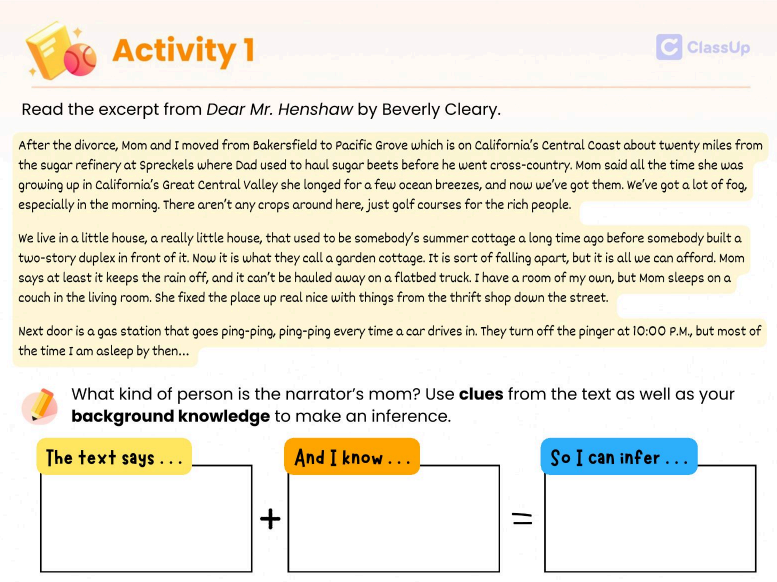
From there students practice on real literary passages — an excerpt from Dear Mr. Henshaw, short scenes where a character sits alone on the bench while teammates celebrate — and fill in the same three boxes themselves: what the text says, what they already know, and the inference those two produce together. By the end, the student isn't guessing at “what does the author mean” questions. They have a method for answering them — the exact method 6th grade reading demands and most classrooms never make explicit.
Why inference is so hard (and why it isn't laziness)
Here's the part that reframes everything. When your child reads a sentence and answers a factual question, the brain does one main job: find the words and report them back. But making an inference asks the brain to do four things at once:
• Hold several pieces of the text in mind at the same time
• Reach into memory for the right piece of background knowledge
• Combine the two without losing track of either
• Land on a conclusion the text never actually states
Reading researchers call this combination a heavy cognitive load. Literal comprehension is locating information; inference demands all of these processes simultaneously, which is far more taxing on a young reader's working memory. When working memory fills up, the wheels come off. Not because the child stopped caring, but because they ran out of mental room mid-sentence.
There's a second, sneakier reason: inference runs on background knowledge and what a child already knows about the world. To infer that a character is nervous, you have to already know that shaking hands imply nerves. When a reader is missing the knowledge a passage assumes, they build a weaker mental picture of the text and the inference simply doesn't arrive. This is why a 6th grader can decode every word on a page about, say, the stock market or the Dust Bowl and still “not get it” — the words aren't the problem; the missing context is.
Put those two together and the picture changes. A child stuck on inference isn't a lazy reader or a careless one. They're a reader whose brain is being asked to juggle more than it can hold, often without the background knowledge the text quietly assumes. That's not a motivation problem. It's a skill — and skills can be taught.
• Hold several pieces of the text in mind at the same time
• Reach into memory for the right piece of background knowledge
• Combine the two without losing track of either
• Land on a conclusion the text never actually states
Reading researchers call this combination a heavy cognitive load. Literal comprehension is locating information; inference demands all of these processes simultaneously, which is far more taxing on a young reader's working memory. When working memory fills up, the wheels come off. Not because the child stopped caring, but because they ran out of mental room mid-sentence.
There's a second, sneakier reason: inference runs on background knowledge and what a child already knows about the world. To infer that a character is nervous, you have to already know that shaking hands imply nerves. When a reader is missing the knowledge a passage assumes, they build a weaker mental picture of the text and the inference simply doesn't arrive. This is why a 6th grader can decode every word on a page about, say, the stock market or the Dust Bowl and still “not get it” — the words aren't the problem; the missing context is.
Put those two together and the picture changes. A child stuck on inference isn't a lazy reader or a careless one. They're a reader whose brain is being asked to juggle more than it can hold, often without the background knowledge the text quietly assumes. That's not a motivation problem. It's a skill — and skills can be taught.
Three things you can do this week
1. Ask "why," not "what." After any reading, skip "what happened?" Instead, ask "why did the author write it that way?" or "why do you think the character did that?" There's no right answer — you're training the habit of going one layer deeper.
2. Hunt for one word in context. "What does 'sharp' mean in 'a sharp reply'?" This builds the exact skill 6th grade tests most.
3. Play "prove it." When your child makes a claim about a story, ask them to point to the line that proves it — rebuilding the evidence skill that's shaky by 6th grade.
2. Hunt for one word in context. "What does 'sharp' mean in 'a sharp reply'?" This builds the exact skill 6th grade tests most.
3. Play "prove it." When your child makes a claim about a story, ask them to point to the line that proves it — rebuilding the evidence skill that's shaky by 6th grade.
How Cosmo helps
This is exactly the gap our live English classes are built to catch. Because every student starts with the assessment behind this report, we can see whether the breakdown is in finding information, reading in context, or analyzing the meaning — instead of guessing. From there, classes are live and personalized: a real teacher works through the actual thinking with your child, explaining it a different way until it clicks, not assigning more pages and hoping.
At Cosmo, ELA live sessions aren't about worksheet completion — they're about figuring out exactly where your child's comprehension breaks down and rebuilding it from there. Every class is live, every teacher is trained to explain things differently until it clicks. If you're not sure where your child stands, a single session tells you more than a semester of report cards. Try a free G6 trial class today!
At Cosmo, ELA live sessions aren't about worksheet completion — they're about figuring out exactly where your child's comprehension breaks down and rebuilding it from there. Every class is live, every teacher is trained to explain things differently until it clicks. If you're not sure where your child stands, a single session tells you more than a semester of report cards. Try a free G6 trial class today!